Shopping Cart


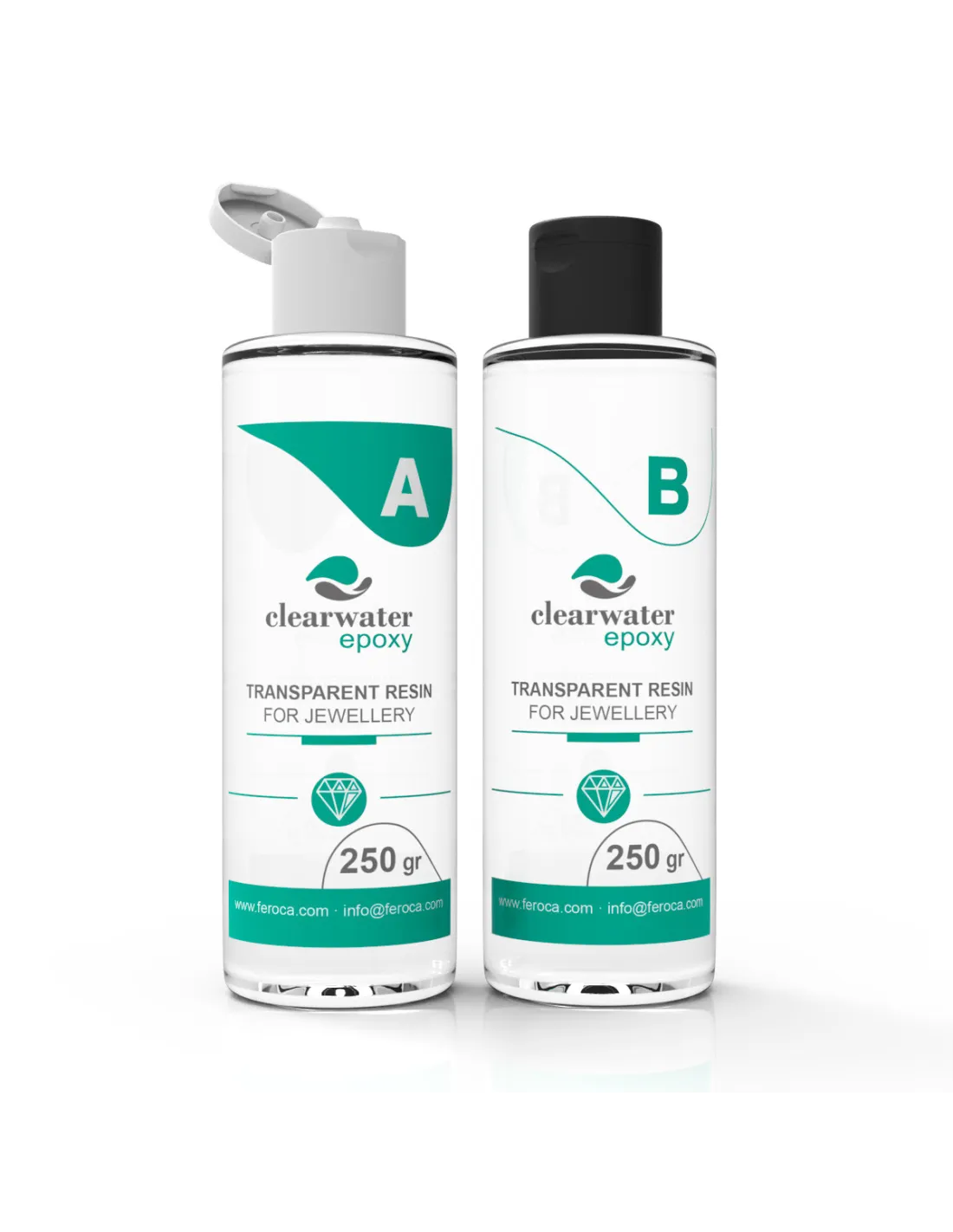
ClearWater Epoxy -Transparent Resin for Jewelry
405801002
€15.00
18,15 € Tax incl.
18,15 € Tax incl.
Transparent epoxy resin for jewellery and art. Mix 100A:100B, 30 min working time, cure in 8-10h. High UV resistance and self-levelling finish.
ClearWater Transparent Epoxy for Jewellery is a two-component epoxy resin formulated to achieve a crystal-clear, self-levelling finish with high UV yellowing resistance. With a simple 1:1 mixing ratio by weight and only 30 minutes of working time, it is the natural choice for jewellery, costume jewellery and artistic projects where transparency and a glossy finish are essential.
Technical specifications
| Parameter | Value |
|---|---|
| Type | Two-component epoxy resin |
| Colour | Transparent |
| Mix ratio (weight) | 100A : 100B |
| Working time | 30 minutes |
| Cure time | 8-10 hours |
| Shore Hardness | 75D |
| Finish | Self-levelling, glossy |
| UV resistance | High |
| Main applications | Jewellery, art, coatings |
What it is used for
Thanks to its fluid viscosity, excellent optical clarity and hard cure (75 Shore D), ClearWater Transparent Epoxy for Jewellery is suitable for any project where you need crystal-clear transparency and lasting durability:
- Making jewellery and costume jewellery: gemstones, pendants, rings, earrings in silicone moulds
- Liquid art and artistic casting: colour layers, cells and marbled effects
- Encapsulation of flowers, insects, photographs or other decorative objects
- Coating and varnishing of wood surfaces, paintings or decorative tables
- Simulating water and aquatic effects in scale models and dioramas
- Creative DIY projects requiring a transparent glossy finish
How to use it
- Prepare the surface or mould. If you use a silicone mould, no release agent is needed. For moulds made of other materials, apply Release Agent 34D in a thin coat and allow to dry before pouring.
- Measure the components. Mix the resin (Component A) and the hardener (Component B) in a 100:100 ratio by weight. Use a precision scale to achieve the exact proportion.
- Mix carefully. Stir slowly with a spatula for at least 2-3 minutes, scraping the sides and bottom of the container thoroughly. Insufficient mixing produces uncured areas.
- Add pigment if desired. Incorporate epoxy-compatible dyes or pigments before pouring. Mix again until the colour is uniform.
- Pour into the mould. Make use of the 30-minute working time. Pour slowly to minimise the incorporation of air bubbles.
- Remove surface bubbles. Gently pass the flame of a workshop torch at a distance of about 10-15 cm over the surface. The heat breaks the bubbles without burning the resin.
- Leave to cure on a level surface. Cover to avoid dust and leave to rest for 8 to 10 hours at room temperature (20-25 °C) until fully cured.
- Demould and finish. Carefully remove the piece from the mould. If you need to polish the edges, use fine-grit wet-and-dry sandpaper and finish with polishing compound.
Safety warning: Components A and B of this epoxy resin are irritants in liquid form. Always work with nitrile gloves, safety goggles and in a well-ventilated space. Once fully cured, the piece is safe and non-toxic. Avoid contact of uncured resin with skin and eyes. Consult the safety data sheet before use.
Usage tips
Working temperature
Temperature directly affects viscosity and cure time. Above 25 °C the resin flows more easily and curing accelerates, but working time is reduced. Below 18 °C viscosity increases and more bubbles may appear. Always work in an environment between 20 and 25 °C for optimum results. In cold weather, you can gently warm the containers in a warm water bath (not exceeding 40 °C) before mixing.
Bubble control in small pieces
For jewellery and small-format pieces, a torch is the most effective tool for removing surface bubbles. You can also place the mould in a vacuum chamber during the first few minutes after pouring if you have one, although with this low-viscosity formulation it is rarely necessary. Avoid over-stirring the mix or using high-speed mixers, which incorporate air.
Layers and successive pours
If you need greater depth (encapsulations with bulky objects or water effects in scale models), work in layers. Pour a first layer, allow it to partially gel (around 4-5 hours, still slightly tacky to the touch) and then pour the next one. Adhesion between layers is optimal when the lower layer has not fully cured. If the first layer has already fully cured, lightly sand the surface with 320-grit sandpaper before applying the next layer to ensure adhesion.
Frequently asked questions
Can I use this resin to simulate water in scale models or dioramas?
Yes. ClearWater Transparent Epoxy for Jewellery is an excellent option for water effects in scale models thanks to its high transparency, fluidity and self-levelling glossy finish. To create waves or foam you can use cotton or fibre soaked in the same resin before it cures.
How do I get bubble-free pieces?
Mix slowly and steadily, avoiding sudden movements. After pouring, pass a torch about 10-15 cm from the surface for a few seconds: the heat reduces surface tension and the bubbles dissolve. Working with the resin at the right temperature (20-25 °C) also helps bubbles rise and escape more easily.
Can I add pigment or dye to this resin?
Yes, you can add paste or liquid pigments compatible with epoxy resins. Add them to Component A before mixing with the hardener, or into the already prepared mix before pouring. Use small amounts so as not to alter the curing properties. For translucent effects, liquid dyes give better results than opaque pigments.
How long do I have to work with the resin once it is mixed?
The working time of ClearWater Transparent Epoxy for Jewellery is approximately 30 minutes at 20-25 °C. After that time the viscosity increases noticeably and the resin begins to gel. If the working temperature is higher, the working time is reduced; if it is lower, it is slightly extended.
Is it resistant to yellowing over time?
This formulation incorporates UV stabilisers that significantly delay yellowing caused by exposure to sunlight. It is suitable for jewellery pieces and decorative objects in regular use. For applications with intense and prolonged sun exposure, such as outdoors or terrariums, consider complementing with a high UV protection topcoat varnish.
Do I need a release agent to use this resin with silicone moulds?
No. Silicone moulds are naturally non-stick and do not require a release agent with epoxy resins. For rigid moulds (resin, wood, plaster, metal), it is necessary to apply a release agent such as 34D to facilitate demoulding and protect the mould.
What hardness does the piece reach once cured?
Once cured, ClearWater Transparent Epoxy for Jewellery reaches a hardness of 75 Shore D, which corresponds to a hard and rigid material, comparable to some nylons or rigid PVC. It is hard enough for jewellery pieces, decorative gemstones and objects that require scratch resistance.
Can I use this resin in contact with food?
No. ClearWater Transparent Epoxy for Jewellery is not certified for Food Safe use. If you need an epoxy resin suitable for food contact, Feroca offers EpoFood, a colourless Food Safe epoxy resin, specifically formulated and certified for that use.
Video tutorials
How to Make a Seehund Submarine Diorama with Feroca Epoxy Resin 🌊🛠️ [English Subtitles 🇬🇧]
Epoxy Resin Lake for a Nativity Scene
📲 Feroca TutoReel: Wargame Bases in Epoxy Resin 💡
Gemstones in Transparent Epoxy · Translux D150
Crystal Skull in Epoxy · Part 1
📲 Feroca TutoReel: Create Your Magic Potions in Epoxy 💡
🍹💫 Feroca TutoReel: Creating Fake Drinks with Transparent Resins! ✨💧
How to Make an Epoxy Resin Pendant
- Color
- Transparent
- Working Time
- 30min
- Curing Time
- 8-10 hours
- Shore Hardness
- 75D
- Volume Mixing Ratio
- 100A:100B
- Type
- Resin
- Application
- Art
Jewelry
No reviews
Tap to zoom