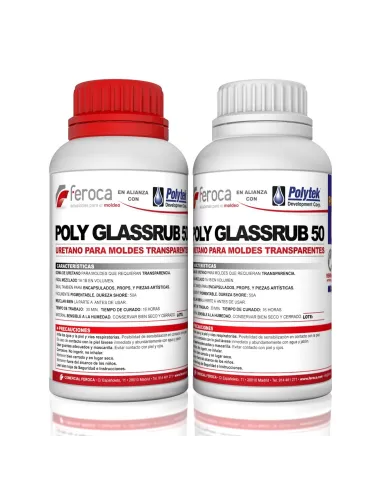
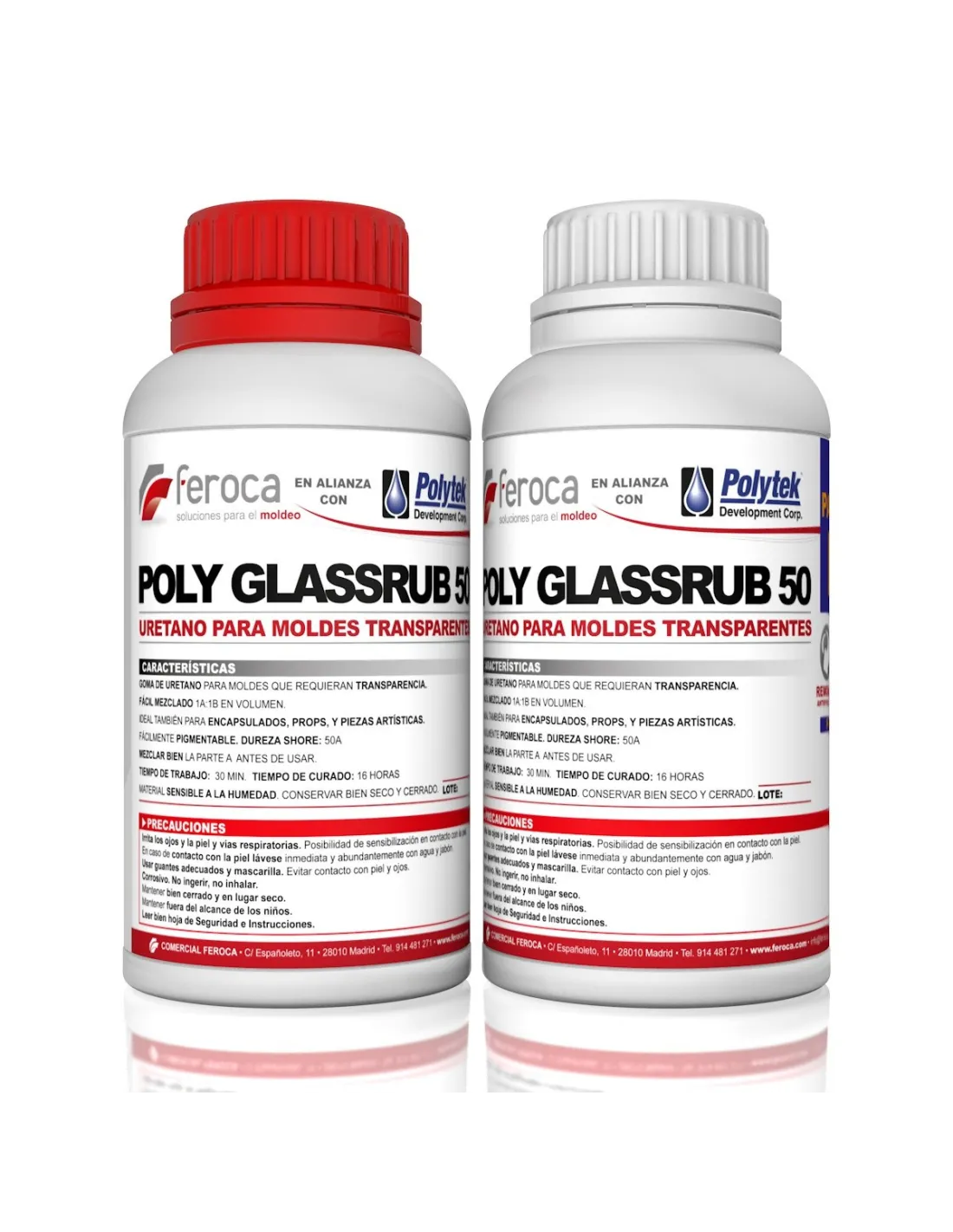
Poly GlassRub 50 is a two-component polyurethane rubber with a characteristic bluish transparency, similar to water. Its low viscosity makes mixing and casting easy, and it cures at room temperature with no appreciable shrinkage, yielding flexible, optically clear parts. It is the natural choice when your project demands seeing inside the mould or achieving visual effects in the final piece.
Technical specifications
| Parameter |
Value |
| Colour |
Bluish transparent |
| Shore Hardness |
A50 |
| Mix ratio by weight |
100A : 100B |
| Mix ratio by volume |
100A : 100B |
| Mixed viscosity |
1,200 cP |
| Pot life |
30 min |
| Cure time (demould) |
16 hours |
| Application |
Casting |
| Specific volume |
27.5 in³/lb |
What it is used for
Its transparency and flexibility make it a versatile material for any application where visibility of the material or the model matters. You can also add special pigments for polyurethane to achieve vivid, translucent colours with great visual depth.
- Making transparent moulds that allow you to see the original during the demoulding process
- Reproductions of artistic and sculptural models with a clean finish
- Moulded decorative pieces: jewellery, design objects, display and retail props
- Special effects: simulation of water, ice, glass or vitreous materials
- Rapid prototyping when internal details of the part need to be checked
- Encapsulation of objects and artistic compositions
- Production of translucent elements with pigmentation for lighting design
How to use it
- Prepare the mould or model. Make sure the surface is clean, dry and free of dust. Apply a suitable release agent to the casting surface to make demoulding easier afterwards.
- Condition the components. Both components must be at room temperature (between 20 and 25 °C). If they are cold, viscosity increases and can make mixing and casting more difficult.
- Weigh or measure the components. Mix part A and part B in a 1:1 ratio both by weight and by volume. The exact ratio is essential for correct curing.
- Mix carefully. Stir both components slowly and steadily for at least 2–3 minutes, scraping the sides and bottom of the container thoroughly to avoid unmixed areas.
- Add pigment if desired. If you want to colour the material, incorporate PolyColor Dyes at this point, mixing again until a uniform colour is achieved.
- Cast in a thin stream. Pour the mixture slowly from a raised point so the thin flow helps eliminate bubbles. If you have a vacuum chamber, degas the mixture before casting.
- Allow to cure. Pot life is 30 minutes. Allow the part to cure at room temperature for 16 hours before demoulding.
- Demould and inspect. Remove the part carefully. Any residual material can be cleaned with a suitable solvent before full cure.
Important notice: Polyurethane rubbers are very sensitive to moisture. Component B (isocyanate) reacts with ambient humidity and can generate bubbles in the part or inhibit correct curing. Always reseal containers after use. Avoid working in environments with relative humidity above 60%. Store components in a cool, dry place with caps tightly closed.
Usage tips
Bubble control
The low viscosity of Poly GlassRub 50 (1,200 cP) already favours the natural release of bubbles, but for parts where transparency is critical it is advisable to degas the mixture in a vacuum chamber for 1–2 minutes before casting. If you do not have a vacuum chamber, pour in a thin stream from height and avoid stirring quickly.
Working temperature and curing
Working below 18 °C slows curing and may produce a milky appearance in the final part. Above 30 °C pot life is notably shortened. The optimum range is 20–25 °C. Do not subject cured parts to temperatures above 60 °C in continuous service, as the material may deform.
Using a release agent and pigment compatibility
Always apply a release agent to the model before casting, especially if the substrate is porous (plaster, wood, cardboard). To colour the material, PolyColor Dyes are compatible with all polyurethane rubbers and allow you to obtain translucent, vivid tones. Add the pigment once both components have been mixed and stir until uniform before casting.
Frequently asked questions
What type of mould is best suited for casting this material?
You can use silicone moulds, rigid polyurethane moulds or even plaster moulds with a release agent. To take full advantage of Poly GlassRub 50's transparency, silicone moulds are the most common choice, as they require no release agent and allow clean demoulding without damaging the part.
Can it be used to make moulds of highly detailed parts?
Yes. Its low viscosity (1,200 cP) allows the material to flow well and reproduce fine details. The additional advantage of Poly GlassRub 50 is that, being transparent, you can visually check that the material has filled every area of the model before it cures.
Can it be pigmented to obtain translucent colours?
Yes, this is one of its most valued applications. Starting from a transparent base, adding PolyColor Dyes produces translucent, luminous colours. The pigment dose determines the intensity of the shade; the less pigment, the greater the transparency.
Is it suitable for outdoor use or contact with water?
The material cures into a stable elastomer, but it is not specifically formulated for prolonged UV exposure or continuous water immersion. For long-term outdoor applications, consult the Feroca technical team to assess whether an additional protective coating is needed.
How much heat can parts made with this rubber withstand?
As with the rest of the polyurethane rubbers in the range, exceeding 60 °C in continuous service is not recommended. Above that temperature the material may soften and permanently deform.
Can it be used to make gaskets or pads that need to absorb impacts?
At Shore A50 hardness it is a medium-flexibility material, suitable for parts that require some cushioning. For high mechanical resistance or structural load applications, check the higher-hardness rubber range such as PT Flex 85.
Can it be mixed with silicone oil to reduce viscosity?
No. Silicone oils are additives designed for tin silicones and are not compatible with polyurethane rubbers. Adding silicone oil can interfere with curing and negatively affect the mechanical properties of the part.
What is the difference between this material and a transparent silicone rubber?
Transparent silicone rubbers offer greater temperature resistance and better behaviour against UV ageing. Poly GlassRub 50, on the other hand, stands out for its very low viscosity, ease of pigmentation with specific colorants and more competitive price. The choice depends on the end use: for long-lasting reusable moulds, silicone is usually preferable; for decorative finished parts or prototypes, Poly GlassRub 50 is a very efficient option.
How much product do I need?Calculate the exact amount before buying and avoid wasting material.
Go to the calculator →