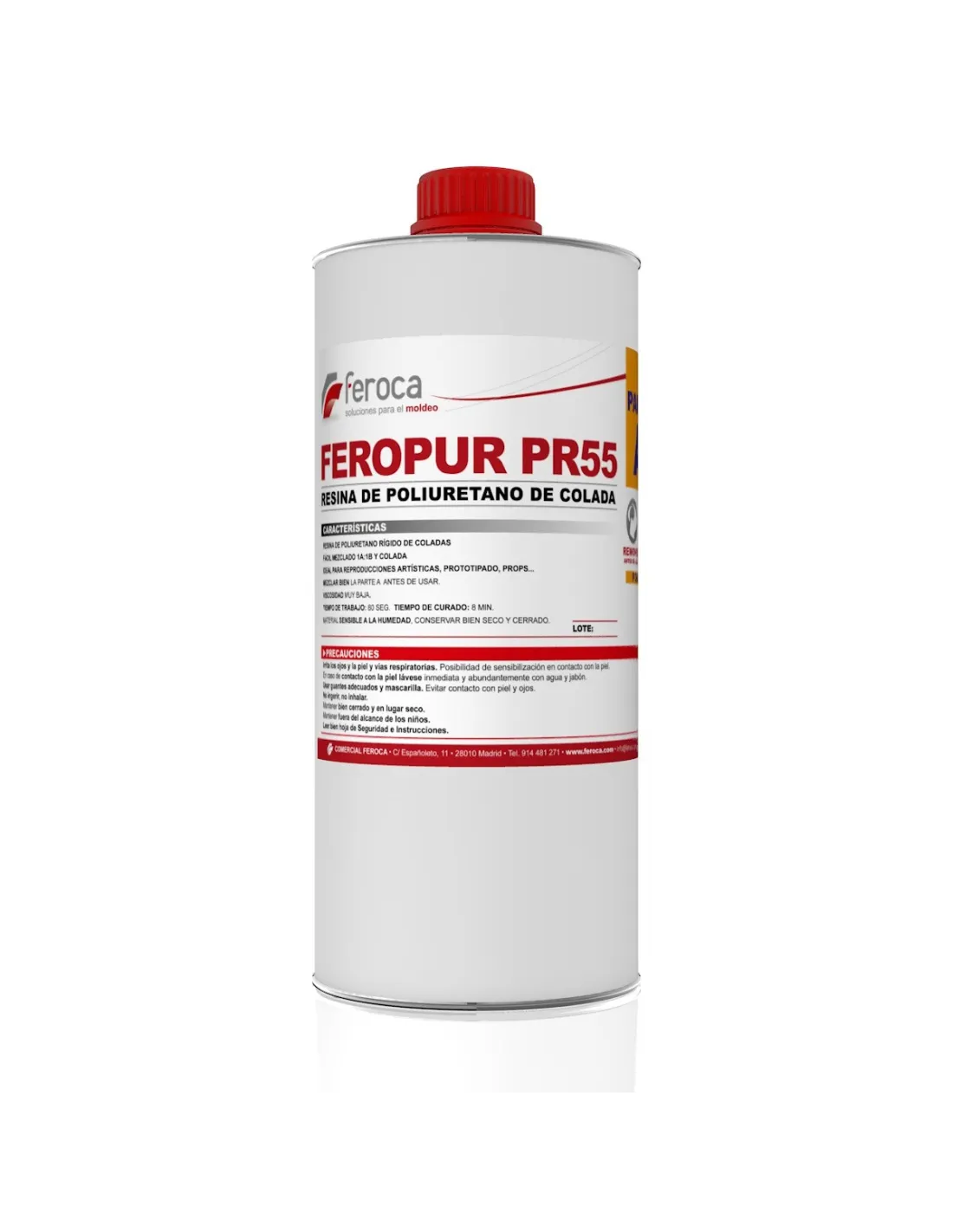
FEROPUR PR 55 Part A is the polyol component of a fast-curing, room-temperature, two-component rigid polyurethane casting system. Combined with Part B (FEROPUR E 55) in a 1:1 ratio by weight and volume, it offers excellent flowability, easy hand mixing and an ultra-fast demoulding cycle ideal for series production.
Technical specifications
Parameter
Value
Component
Part A (polyol)
Part A colour
Ivory / colourless
Mix ratio by weight
100 A : 100 B
Mix ratio by volume
100 A : 100 B
Pot life
80 seconds
Cure / demould time
~2 minutes
Final hardness (Shore D)
70 D
Cure system
Room temperature
What it is used for
FEROPUR PR 55 is the go-to rigid polyurethane for high-fidelity reproductions and prototypes where cycle speed is the priority. Its low viscosity ensures complete mould filling even in complex geometries, and its final Shore 70D hardness makes it suitable for both functional and decorative parts.
Reproduction of parts in highly detailed silicone moulds
Manufacture of scale models, prototypes and industrial models
Series production of figures, sculptures and decorative elements
Rigid negatives and counter-moulds
Prop-making and special effects
Reproduction of architectural and ornamental reliefs
Parts with mineral fillers to adjust weight, texture or surface finish
How to use it
Prepare the materials. Before starting, vigorously shake Part A to homogenise any settled material. Work in a dry environment; ambient humidity inhibits polyurethane curing.
Apply release agent. Coat the mould with a release agent suitable for polyurethane and allow the solvent to evaporate before casting.
Weigh the components. Weigh 100 parts of Part A and 100 parts of FEROPUR E 55 Part B in separate containers. The ratio is strictly 1:1 by weight and by volume.
(Optional) Add filler. If you wish to adjust viscosity or the final appearance, incorporate the desired filler into each component separately and disperse thoroughly before mixing.
Mix. Pour Part B onto Part A and mix vigorously and uniformly for 20–30 seconds, scraping the sides and bottom of the container thoroughly.
Cast immediately. You have approximately 80 seconds of pot life. Pour the mixture into the dry mould from a low point to minimise air entrapment.
Demould. The part can be demoulded after 2 minutes. Full cure and final hardness are reached after 24 hours.
Important notice — Isocyanate polyurethane (Part B) Part B contains isocyanates. Always work with adequate ventilation and wear nitrile gloves, safety goggles and a respirator mask if there is any risk of vapour inhalation. Isocyanates are irritants to the respiratory tract and skin. Consult the full safety data sheet before handling the product.
Polyurethane is highly sensitive to moisture. Do not use damp moulds or work in high-humidity environments. Close containers tightly after each use to prevent moisture absorption by Part B.
Usage tips
Series production cycles
The 2-minute demould time is the key advantage of this system. With a single silicone mould you can maintain a very high production rate. Prepare the mixing containers and release agent before starting the run so you don't lose pot life between castings. If you are working with the complete FEROPUR PR55+E55 kit, make sure to re-shake Part A before each weighing if it has been left to stand.
Use with mineral fillers
Adding filler (carbonate, talc, quartz, etc.) to each component separately before combining them lets you adjust the viscosity, final weight and appearance of the part. Disperse it thoroughly with a spatula before joining the components. Bear in mind that filler reduces the available pot life, so work quickly.
Temperature and storage
The optimal working temperature is between 20 and 25 °C. Below 18 °C viscosity increases and curing slows down; above 30 °C pot life shortens noticeably. Store containers tightly closed in a cool, dry place away from moisture. Once opened, Part B (isocyanate) should be used as quickly as possible to prevent degradation through moisture absorption.
Frequently asked questions
Is it necessary to use a release agent with this type of resin?
Yes, it is highly recommended. Polyurethane tends to adhere to many surfaces, especially resin or plaster moulds. In silicone moulds adhesion is lower, but applying a release agent specifically designed for polyurethane extends mould life and eases demoulding without damaging fine details. Apply a thin coat and allow the solvent to evaporate before casting.
Can this type of resin be pigmented?
Yes. You can add polyurethane-compatible pigments directly to Part A before mixing. Use moisture-free pigments at low proportions (generally no more than 3–5% of total weight) to avoid altering the mechanical properties of the system. Polyurethane-based paste pigments give better results than untreated powder pigments.
What happens if the mould is not completely dry?
Moisture is the main enemy of polyurethane. If the mould contains residual moisture, the isocyanate (Part B) reacts with it and generates carbon dioxide bubbles in the part. The result is internal or surface porosity that ruins the finish. Always ensure the mould is completely dry before casting FEROPUR PR 55.
Why does pot life sometimes shorten?
Polyurethane pot life depends directly on temperature. At higher ambient temperatures, or if the components are warm, the reaction accelerates and pot life can drop significantly below the stated 80 seconds. Work between 20–25 °C and, if possible, keep containers in a cool place before use.
Can I add filler to change the viscosity or finish?
Yes. FEROPUR PR 55 accepts mineral fillers (calcium carbonate, talc, glass microspheres, etc.) to adjust viscosity, weight, surface appearance or reduce cost per part. Add the filler to each component separately and disperse thoroughly before combining them. The higher the filler proportion, the shorter the available pot life.
When does the part reach its final hardness?
Demoulding is possible at 2 minutes, but the part does not reach its final Shore 70D hardness until 24 hours of curing at room temperature have elapsed. For applications requiring machining, sanding or assembly, wait that minimum time. A post-cure in an oven at low temperature (50–60 °C) can accelerate the attainment of final properties.
What type of mould is most suitable for this system?
Silicone moulds (both condensation and addition) are the most common choice due to their ease of demoulding and ability to reproduce fine details. Epoxy resin, polyester or plaster moulds can also be used, always with the appropriate release agent. Avoid moulds with surface moisture or made from materials that react with isocyanates.
Is this product suitable for functional parts or only decorative ones?
With a Shore 70D hardness, FEROPUR PR 55 produces rigid parts suitable for both decorative applications (figures, ornaments, reliefs) and certain functional uses that do not involve severe impacts or flexing. For parts requiring greater structural strength or elasticity, please consult other references in the Feroca catalogue.
How much product do I need?Calculate the exact amount before buying and avoid wasting material.
Cookies on this site are used to personalise content and ads to deliver social media features and to analyse traffic. We also share information about your use of the site with our social media partners for advertising, personalisation and web analytics.. More information.