Shopping Cart


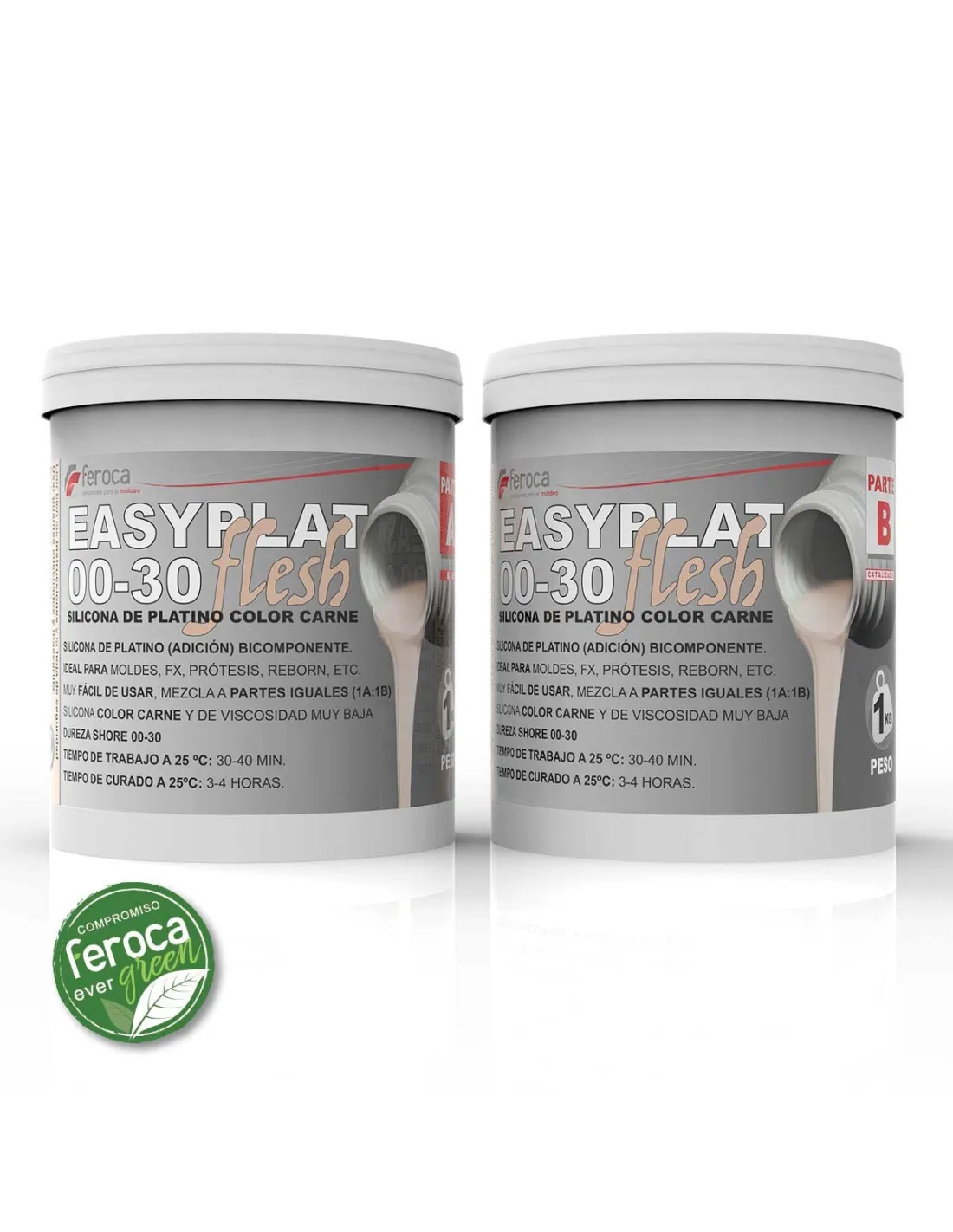
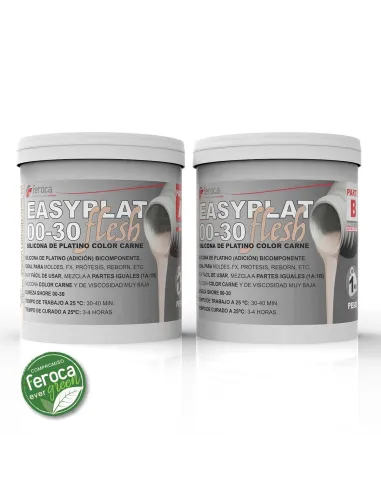
EASYPLAT FLESH 00-30 -Flesh-colored Platinum Silicone-
201354101
€48.00
58,08 € Tax incl.
58,08 € Tax incl.
Flesh-tone platinum silicone, 1:1 mix ratio, Shore Hardness 00-30. Extremely soft and flexible. Ideal for prosthetics, FX, animatronics and Reborn dolls.
EASYPLAT FLESH 00-30 is a two-component platinum (addition) silicone in flesh tone with Shore Hardness 00-30, designed for applications requiring extreme flexibility and a hyperrealistic appearance. Its equal-parts mix ratio (1A:1B) and low viscosity make it accessible to both special effects professionals and prosthetics artists and Reborn doll makers.
Technical specifications
| Parameter | Value |
|---|---|
| Type | Two-component platinum (addition) silicone |
| Colour | Flesh |
| Shore Hardness | 00-30 |
| Mix ratio (weight) | 100A : 100B |
| Mix ratio (volume) | 100A : 100B |
| Mixed viscosity | 2800 mPa·s |
| Working time at 25 °C | 30-40 min |
| Cure / demould time at 25 °C | 3-4 hours |
| Tensile strength | ≥ 0.85 MPa |
| Tear strength | ≥ 2.4 kN/m |
What it is used for
Its ultra-soft Shore Hardness (00-30) and flesh tone make it a benchmark for any work requiring the faithful replication or simulation of human tissue. Its most common applications include:
- Fabrication of character prosthetics and anaplastology pieces (nipples, ears, noses, etc.)
- Special effects (FX) for film, television and theatre
- Parts and skins for animatronics and hyperrealistic puppets
- Reborn dolls and ultra-realistic collectible figures
- Silicone masks and silicone skins for professional cosplay
- Hyperrealistic replicas of body parts
- Flexible moulds for complex geometries and undercut pieces
How to use it
- Prepare the surface or original. Make sure the model is clean and free of cure-inhibiting contaminants (latex, tin silicone, sulphur-containing clays, fresh epoxy, etc.). Apply a release agent if necessary.
- Weigh or measure the parts. Mix component A and component B in a 1:1 ratio by both weight and volume. Use a precision scale for critical work.
- Mix thoroughly. Stir for 2-3 minutes with a spatula, scraping the sides and bottom of the container carefully, until you achieve a uniform colour with no streaks.
- Degas if you have a vacuum chamber. Apply vacuum for 1-2 minutes to remove bubbles, especially for thin moulds or high-definition prosthetics.
- Pour or apply. Thanks to its low viscosity (2800 mPa·s), you can pour in a thin stream or apply with a brush. If using a thixotropic additive, apply it beforehand to control sagging on vertical surfaces.
- Working time: 30-40 minutes. Work within that window; after that time, the silicone begins to gel and cannot be manipulated without defects.
- Cure at room temperature. Allow to rest at 25 °C for 3-4 hours before demoulding. Heat accelerates curing; cold slows it down.
- Demould carefully. Thanks to its extreme flexibility, you can fold or turn the mould inside out without risk of tearing.
- Pigment if necessary. Add pigments specifically formulated for platinum silicone before pouring to customise the flesh tone or add veins and intradermal details.
Warning: risk of cure inhibition (platinum silicone)
EASYPLAT FLESH 00-30 is a platinum-cure silicone. Contact with certain substances can inhibit curing, leaving the silicone permanently tacky or uncured. The main inhibitors are:
EASYPLAT FLESH 00-30 is a platinum-cure silicone. Contact with certain substances can inhibit curing, leaving the silicone permanently tacky or uncured. The main inhibitors are:
- Tin (condensation) silicones and their residues
- Latex in any form (gloves, surfaces, moulds)
- Clays and plastilines containing sulphur (always check your clay's technical data sheet)
- Freshly cast or incompletely cured polyester and epoxy
- Urethane rubbers
- Petroleum jelly and some organic lubricants
- Unsealed metals and other contaminated surfaces
Usage tips
Temperature control to adjust working times
The stated times (30-40 min working time, 3-4 h cure time) correspond to 25 °C. In summer or in warm workshops, the mix may gel sooner; in winter, curing may be significantly longer. If you need more manipulation time, chill the components in a refrigerator (without condensation) before mixing. To accelerate curing, you can apply gentle heat using an oven or heat blanket at 40-50 °C.
Prosthetics and encapsulated applications
For professional prosthetics requiring edges that blend into the skin, combine EASYPLAT FLESH 00-30 with an encapsulant such as Skin Imitator. If you need an even softer, "dead-feeling" silicone, you can add deadener at a ratio of between 180% and 200% relative to the total mixed silicone, which provides a tactile feel extremely close to real skin. Use pigments specifically formulated for platinum silicone to intrinsically colour the material and add vascular detail before pouring.
Compatibility with moulds and reproduction materials
Always verify that the mould you intend to cast EASYPLAT FLESH 00-30 into is not made from tin silicone or sulphur-containing materials, as these will inhibit curing. Polyurethane resin moulds, sealed plaster or platinum silicone moulds are the safest options. Always apply a release agent between platinum silicones to prevent pieces from bonding to the mould. If you plan to make multiple copies, a rigid shell mould (plaster or resin) is essential to maintain the geometry of the soft mould during casting.
Frequently asked questions
What materials can inhibit the cure of a platinum silicone?
The main inhibitors are: tin (condensation) silicones, latex, sulphur-containing clays, incompletely cured epoxy and polyester, urethane rubbers, petroleum jelly and unsealed metal surfaces. With EASYPLAT FLESH 00-30, it is essential to carry out a preliminary cure test on the original if there is any doubt about material compatibility. If the silicone remains tacky after the stated cure time, contact inhibition is the most likely cause.
Can I use tin silicone and platinum silicone in the same project?
They are not directly compatible. Platinum silicone such as EASYPLAT FLESH 00-30 will not cure if it is in contact with tin silicone; it becomes inhibited and remains permanently tacky. If you need to use both in the same project, you must ensure there is no point of contact between them, or use a barrier sealer.
How long should I wait before demoulding?
EASYPLAT FLESH 00-30 has a demould time of 3-4 hours at 25 °C. Demoulding earlier can cause permanent deformation of the piece or the mould, as the silicone will not yet have reached its final mechanical properties. If the ambient temperature is below 25 °C, wait longer or apply gentle heat to ensure complete curing.
Is a vacuum chamber necessary to eliminate bubbles?
It is not mandatory, but it is highly recommended for high-definition work such as prosthetics or hyperrealistic replicas. The low viscosity of EASYPLAT FLESH 00-30 (2800 mPa·s) helps bubbles escape on their own if poured in a thin stream from a height. For professional results without a vacuum chamber, mix slowly and pour carefully. With a vacuum chamber, apply 1-2 minutes of vacuum after mixing for a completely clean surface.
Can a deadener be added to achieve an even softer texture?
Yes. For encapsulated prosthetic applications requiring a tactile feel very close to real skin, deadener can be incorporated into the EASYPLAT FLESH 00-30 mix. The standard ratio for prosthetics is 180%-200% deadener relative to the total mixed silicone (1A+1B). Bear in mind that increasing the amount of deadener reduces the mechanical strength of the final piece.
How is the silicone pigmented to customise the tone?
You must use pigments specifically formulated for platinum silicones. Water-based or conventional oil-based pigments are not compatible and may inhibit curing. Add the pigment to component A before mixing with component B, and blend thoroughly. EASYPLAT FLESH 00-30 already has a base flesh tone, so small amounts of pigment are sufficient to fine-tune the shade to each subject's skin.
Can this silicone be used to make a Life Cast directly on skin?
EASYPLAT FLESH 00-30 is not intended for direct application on skin as an impression-taking material. For Life Casting on the human body, the appropriate choice is a product specifically formulated for that purpose, such as KEY-FORM. EASYPLAT FLESH 00-30 is used in the reproduction phase — that is, to cast the final piece inside the mould obtained from the Life Cast.
Is a shell mould necessary when working with this silicone?
When EASYPLAT FLESH 00-30 is used as a mould material, it is recommended to make a rigid shell mould (plaster, resin or similar) to act as a support jacket. Since the silicone is extremely soft (Shore 00-30), without a shell mould it will deform during the casting of the reproduction material, compromising the dimensional accuracy of the copies.
- Color
- Meat
- Working Time
- 30-40min
- Curing Time
- 3-4horas
- Shore Hardness
- 00-30
- Volume Mixing Ratio
- 100A:100B
- Mixed Weight Ratio
- 100A:100B
No reviews
Tap to zoom