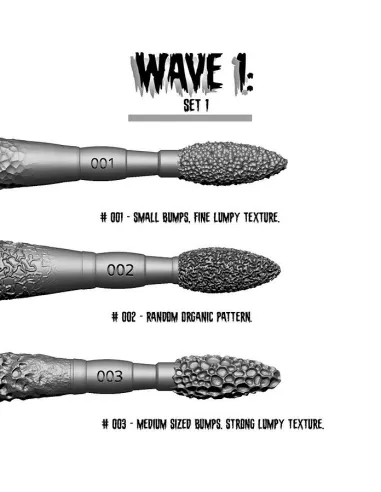
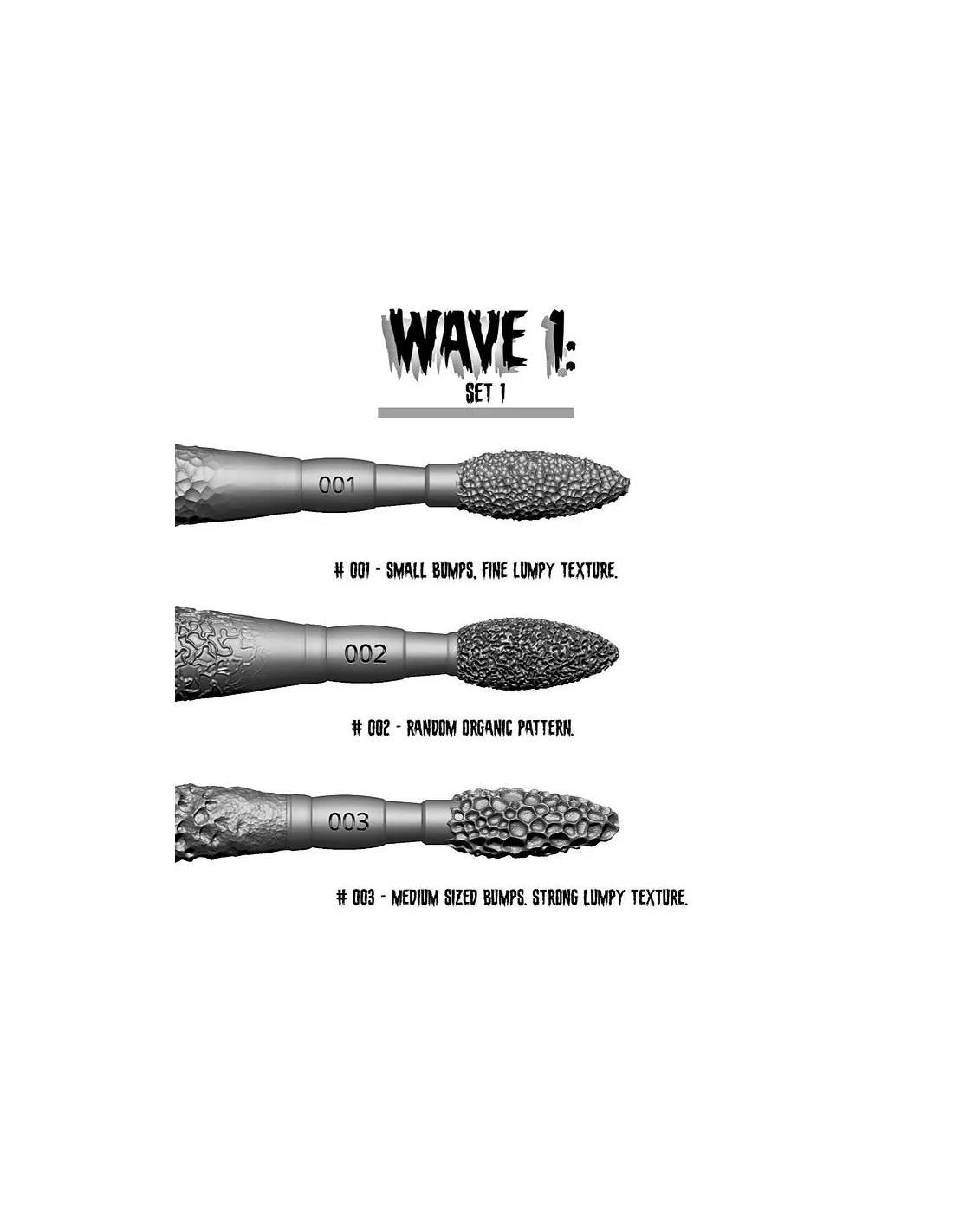
The Texture Wave1 - Set 1 brings together 3 roller texturing tools, each with 3 integrated texture sizes, printed in impact-resistant resin using 3D technology. They are specifically designed to work in hard-to-reach areas and achieve microtextures on silicone sculptures, prosthetics and special effects pieces where a conventional roller lacks sufficient precision.
Technical specifications
| Feature |
Detail |
| Set contents |
3 roller tools |
| Textures per tool |
3 sizes of the same texture (handle also acts as a roller) |
| Total texture rollers |
9 in 1 package |
| Manufacturing material |
Impact-resistant 3D resin |
| Included textures |
Wave1-001, Wave1-002 (fine microtextures), Wave1-003 (lumpy organic texture) |
| Compatibility |
Professional sulfur-free clays, polymer clays, soft modelling compounds |
| Recommended use |
Small and medium prosthetics, detail sculpting, special effects |
What it is used for
The Texture Wave1 - Set 1 is designed for special effects sculptors, prosthetics makers and artists who need to apply microtextures quickly, repeatably and without edge marks in the texture. The geometry of the rollers allows the texture to be easily tileable (no visible seams when repeated), something especially valuable on silicone or artificial skin pieces.
- Texturing small and medium facial prosthetics (noses, ears, chins)
- Access to difficult areas: nasal commissures, behind the ears, folds
- Very fine skin microtextures with Wave1-001 and Wave1-002
- Coarse organic textures for reptile skin, creatures or alien surfaces with Wave1-003
- Character sculpting for film, television and theatre
- Production of masters in Monster Clay Medium or similar sulfur-free clays
- Finishing pieces for subsequent silicone moulding
How to use it
- Prepare the sculpture in a professional sulfur-free clay or polymer clay. The surface should be smoothed and at the appropriate working temperature (slightly warm to facilitate texture impression).
- Select the Wave1-001 or Wave1-002 roller for fine skin microtextures, or Wave1-003 if you want a more pronounced organic texture.
- Choose the appropriate roller size for the area to be textured: the smallest roller for corners and hard-to-reach spots, larger ones for flat or broadly curved surfaces.
- Apply the roller with uniform, consistent pressure, making passes in the same direction to achieve a tileable texture with no visible seams.
- In hard-to-reach areas (commissures, folds), use the handle as an additional roller, taking advantage of its integrated texture design.
- Check the result under raking light to verify texture uniformity before continuing with the mould.
- To clean the tools between uses, apply isopropyl alcohol 99.9% with a soft cloth and allow to dry completely before storing.
Usage tips
Clay working temperature
Texture impression improves noticeably when the clay is slightly above room temperature. If the surface is too cold and rigid, the texture will be shallow and poorly defined. If it is too soft, the roller may sink into or deform the sculpture. With Monster Clay Gray Medium or the standard version, warming it briefly with a hairdryer on a low setting usually gives the best results.
Pressure and pass direction
Keep pressure constant throughout each pass and do not change direction mid-stroke. The Wave1 roller textures are designed to be tileable, but only if passes are made in a consistent direction. On curved areas such as the wing of the nose, work in small arcs following the surface curvature rather than attempting long straight passes.
Cleaning and tool maintenance
Clay residue in the roller grooves can distort the texture on successive passes. Always clean the tools after each session with isopropyl alcohol 99.9% and a soft-bristle brush. Avoid aggressive solvents such as acetone, which can attack the 3D-printed resin the tools are made from.
Frequently asked questions
What modelling materials do these texture rollers work with?
The Texture Wave1 - Set 1 works with any modelling material that has the right consistency to receive an impression: professional sulfur-free clays such as Monster Clay, polymer clays and similar compounds. The key is that the material is at the optimal working temperature — neither too cold nor excessively soft. They are not designed for use on already cured or hardened materials.
What is the difference between the three texture patterns in the set?
Wave1-001 and Wave1-002 produce very fine skin microtextures, practically impossible to achieve with conventional sculpting tools and particularly suited to realistic facial prosthetics. Wave1-003 produces a coarser organic texture, ideal for reptile skin, fictional creatures or any surface requiring pronounced irregularity. Each tool includes three sizes of its respective texture.
Can these rollers be used in small, hard-to-reach areas?
Yes, that is precisely their strong point. The compact design of the smaller rollers, combined with the handle itself acting as an additional roller, makes it possible to work in areas such as the nasal commissure, behind the ears or in deep folds where a large roller cannot manoeuvre with precision.
Does the texture show visible seams when the pass is repeated?
No, as long as a consistent pass direction is maintained. The textures in the Texture Wave1 - Set 1 are designed to be tileable — meaning that consecutive passes continue the texture without interruptions or visible join marks. This is essential in prosthetics where large surfaces need to be covered with a uniform pattern.
How do you clean these tools without damaging them?
The recommended cleaning method is with isopropyl alcohol 99.9% and a soft-bristle brush or cloth. Avoid aggressive solvents such as acetone, which can degrade the 3D-printed resin the tools are made from. A good habit is to clean them at the end of each work session so that the grooves do not accumulate hardened clay residue.
Are these tools suitable for beginners in prosthetics sculpting?
Yes. The Texture Wave1 - Set 1 greatly simplifies the texturing process, which when done manually with conventional sculpting tools requires a great deal of time and practice. Even a user with little experience can achieve professional texturing results simply by controlling pressure and pass direction. The most important thing is to work with the clay at the correct temperature.
Can these rollers be used for textures beyond skin and prosthetics?
Absolutely. Although their design is aimed at prosthetics and special effects, any sculptor or model maker can use them to add repeating textures to decorative pieces, figures, scale models or any project where a uniform textured surface is needed on soft modelling materials.
Which clay is recommended for use with these texture tools?
For prosthetics and special effects, Monster Clay Medium and Monster Clay Gray Medium are two widely used options thanks to their stable behaviour and medium hardness, which allows the roller impression to register well without excessive deformation. Both are sulfur-free, making them compatible with subsequent platinum silicone moulds.