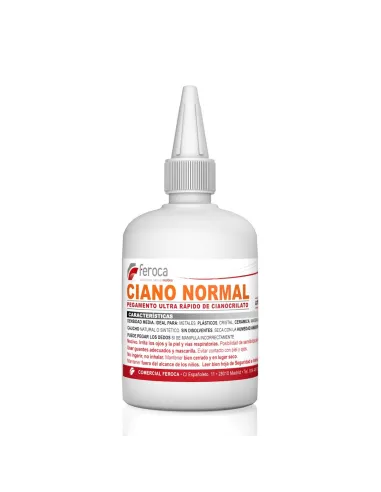
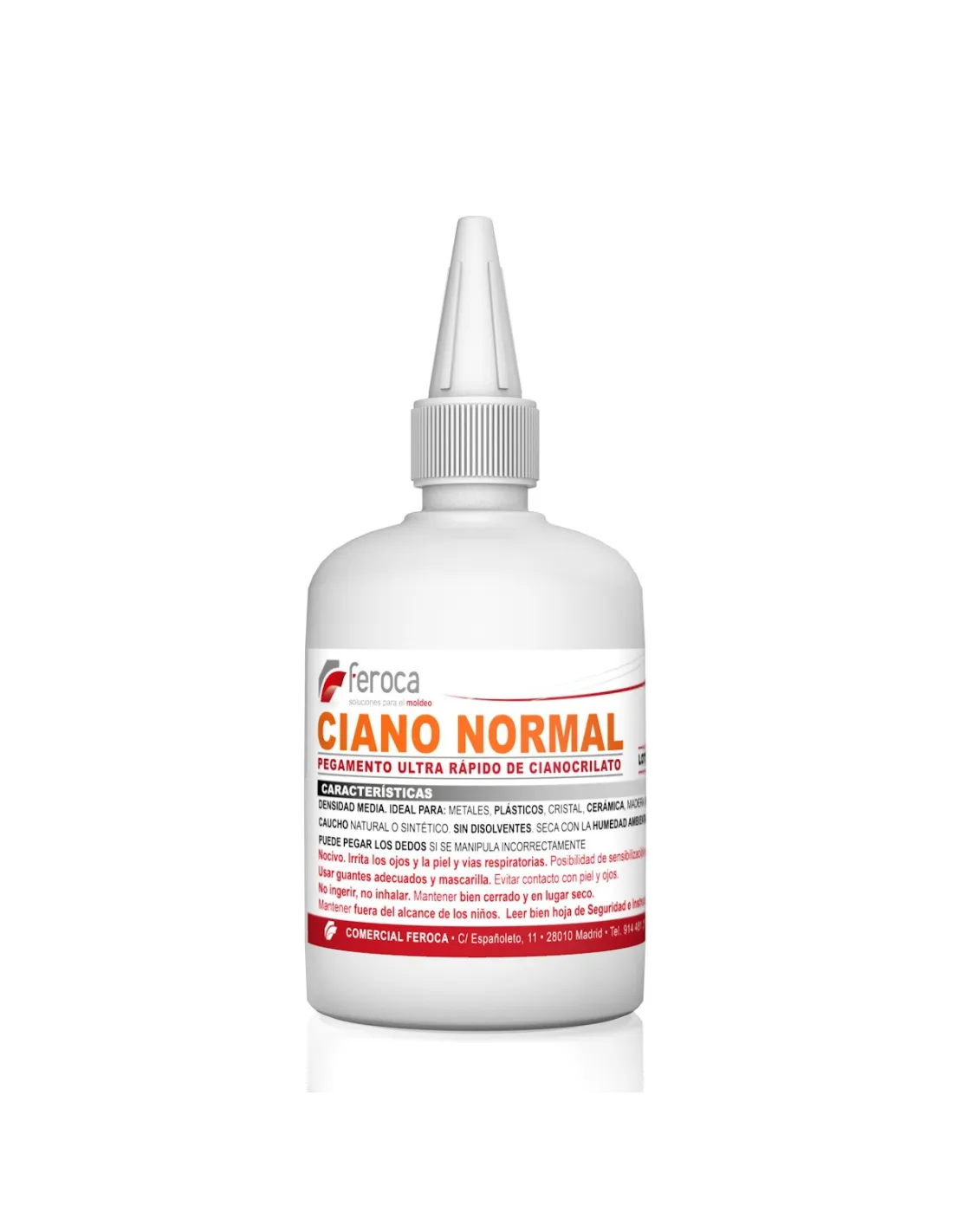
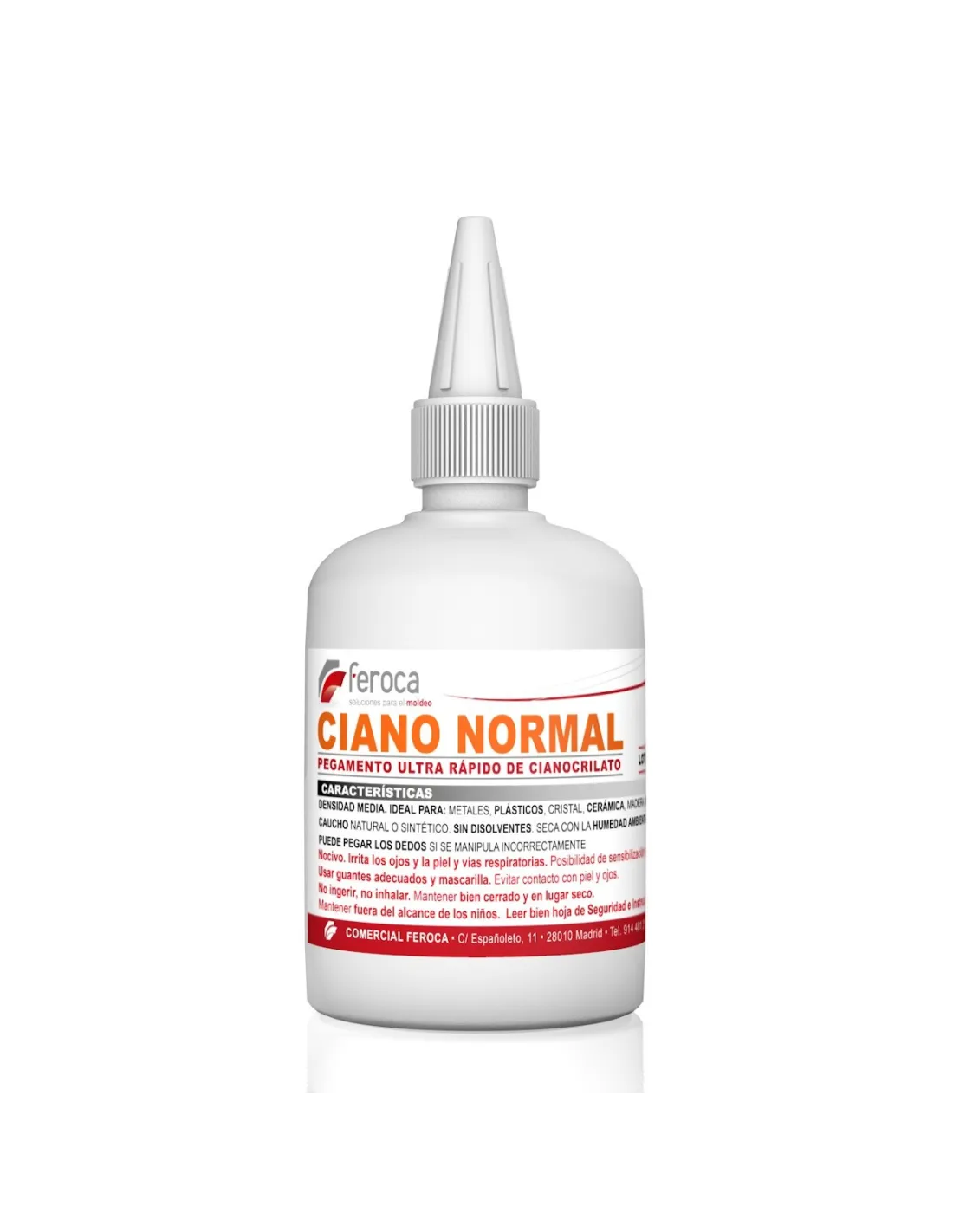
Ciano Normal is a single-component cyanoacrylate adhesive with medium viscosity, designed for fast and clean bonding in professional workshop use. It reacts with ambient moisture without the need for mixing or solvents, providing firm adhesion on most substrates in seconds. If you need more fluidity for narrow joints, see the Ciano muy Líquido; if you need more body for porous surfaces or gaps, the Ciano Denso is your option.
Technical specifications
| Parameter |
Value |
| Type |
Single-component cyanoacrylate |
| Density / viscosity |
Medium |
| Cure |
By ambient moisture (fast) |
| Solvents |
None |
| Number of components |
1 |
| Format |
50 g |
| Bondable materials |
Metals, plastics (most), glass, ceramics, wood, leather, natural and synthetic rubber |
What it is used for
Ciano Normal covers an extremely wide range of applications in special effects workshops, model making, prototyping and industrial repairs. Its medium viscosity makes it the most versatile cyanoacrylate adhesive in the range: it flows enough to penetrate the joint without running out of it.
- Bonding model and scale kit parts (wood, plastic, metal)
- Joining foam, EVA foam elements in the production of props and stage dressing
- Repairing ceramic, glass and porcelain pieces in the workshop
- Fixing metal inserts into resin or composite parts
- Bonding leather and natural or synthetic rubber for prosthetics, masks and costumes
- Quick bonds during the moulding or prototype assembly process
- Emergency repairs on film sets or theatrical productions
- General industrial applications requiring a clean bond with no visible residue
How to use it
- Prepare the surfaces: make sure they are clean, dry and free of grease, dust or release agent residue. Contamination is the most common cause of poor cure.
- Apply a thin layer: deposit a small amount onto one of the two surfaces. With cyanoacrylate, less is more: excess slows down curing and weakens the bond.
- Join the parts immediately: bring both surfaces together and press firmly for 10–30 seconds. The initial contact time is critical for final bond strength.
- Wait for full cure: although the initial bond forms in seconds, maximum mechanical strength is reached after 24 hours.
- Clean the dispenser: wipe the nozzle with a dry cloth before closing the container to prevent it from clogging. Store the bottle closed, in a cool, dry place away from sunlight.
- Speed up the process if needed: you can apply the Spray Acelerador de Ciano to the opposite surface to reduce cure time to just a few seconds, especially useful on low-moisture materials or in low ambient humidity conditions.
Caution: cyanoacrylate bonds skin instantly. If skin contact occurs, do not pull forcefully: wash repeatedly with warm water and soap to gradually dissolve the adhesive. Avoid contact with eyes. Work in a ventilated area, as vapours are irritating to mucous membranes. Keep out of reach of children.
Usage tips
Control the amount applied
With Ciano Normal, the optimal amount is the minimum that covers the contact surface in a uniform layer. If adhesive appears at the edges when joining the parts, you have applied too much. Excess creates stress points, can cause whitening of the area and makes subsequent sanding more difficult. On porous surfaces such as wood or plaster, a quick coat of sealer or the first layer of cyanoacrylate itself (allowed to dry before bonding) reduces absorption and improves results.
Temperature and humidity, your allies
Cyanoacrylate cures by reacting with ambient moisture. In low humidity conditions (very dry or cold environments) curing is slower. In those conditions, the Spray Acelerador de Ciano is the most practical solution: apply it to the surface opposite the one carrying the adhesive, join and press. You can also breathe gently onto one of the surfaces before joining to add localised moisture.
Storage and shelf life
Store the closed container in a refrigerator (between 2 and 8 °C) if you are not going to use it for several weeks: the cold slows internal polymerisation and significantly extends shelf life. Before use, allow the bottle to reach room temperature to prevent condensation at the nozzle. If the adhesive becomes viscous or gels, it has started to cure inside the container and its effectiveness will be compromised.
Frequently asked questions
What is the difference between a medium-viscosity cyanoacrylate and a very thin or thick one?
Viscosity determines how the adhesive flows into the joint. The Ciano muy Líquido penetrates by capillary action into very narrow joints or very porous materials. Ciano Normal (medium viscosity) is the most versatile and covers most situations. The Ciano Denso stays in place on vertical surfaces or with small gaps without running. Choose based on the fit of your parts and the porosity of the material.
Does it work on all plastics?
Most hard plastics (ABS, polystyrene, acrylic, rigid PVC, nylon) bond well with cyanoacrylate. Polyethylenes (PE), polypropylenes (PP) and PTFE are low surface energy materials that do not accept this type of adhesive without prior treatment (primer or specific activator). If you are unsure about the type of plastic, test on a non-visible area.
How long does it take to reach maximum strength?
Initial bonding occurs in 10–60 seconds depending on the material and ambient humidity. However, full mechanical strength is not reached until 24 hours of cure. For critical applications, do not subject the bond to stress during that period.
How can a cyanoacrylate bond be debonded?
Acetone (unscented nail polish remover) effectively dissolves cyanoacrylate. Apply a few drops to the joint, wait a few minutes and gently separate with a spatula. On skin, acetone also works, although prolonged washing with warm water and soap is the most recommended approach. Never forcibly pull bonded skin apart.
Does the adhesive resist water and moisture once cured?
Yes, once cured cyanoacrylate offers reasonable resistance to moisture and water. However, it is not the best option for continuous immersion or steam exposure. For those conditions, a two-component epoxy adhesive or a silicone such as Elastosil A07 offer greater durability.
Why does a white mark appear around the bond?
This is the so-called "blooming" or crazing, caused by cyanoacrylate vapour condensing on cold or porous surfaces. It occurs especially when applying too much or when using too much accelerator. To minimise it, apply the smallest possible amount and ventilate the area well. If the aesthetic finish is critical, lightly sand and apply a finish coat or paint once the bond is fully cured.
Can I use it with sculptures or polymer clay pieces?
Yes. Cyanoacrylate bonds cured polymer clay pieces such as Super Sculpey perfectly, either to each other or onto metal, wood or compatible plastic bases. Make sure the piece is fully cured and clean before applying the adhesive.
Is the accelerator essential?
It is not essential, but the Spray Acelerador de Ciano is very useful when you need near-instant curing, when working in dry environments or with low-porosity materials that do not provide enough moisture for the reaction. Under normal workshop conditions cyanoacrylate cures on its own without accelerator.