
Shopping Cart
- Feroca
- Epoxy Resins
- 0 likes
- 1248 views
- 0 comments
You have a silicone mould ready and a figure, a bust or a replica that you are going to paint afterwards. The question is always the same: should I cast it in polyurethane resin or in epoxy resin? Both copy a mould well, but they do not behave the same way when what you want is fine detail, parts that do not warp and a surface that holds paint well. In this guide we are not going to go over the chemistry of each family (you already have that in our guide to types of resin): we go straight to the practical decision for painted figures and replicas.
The short answer
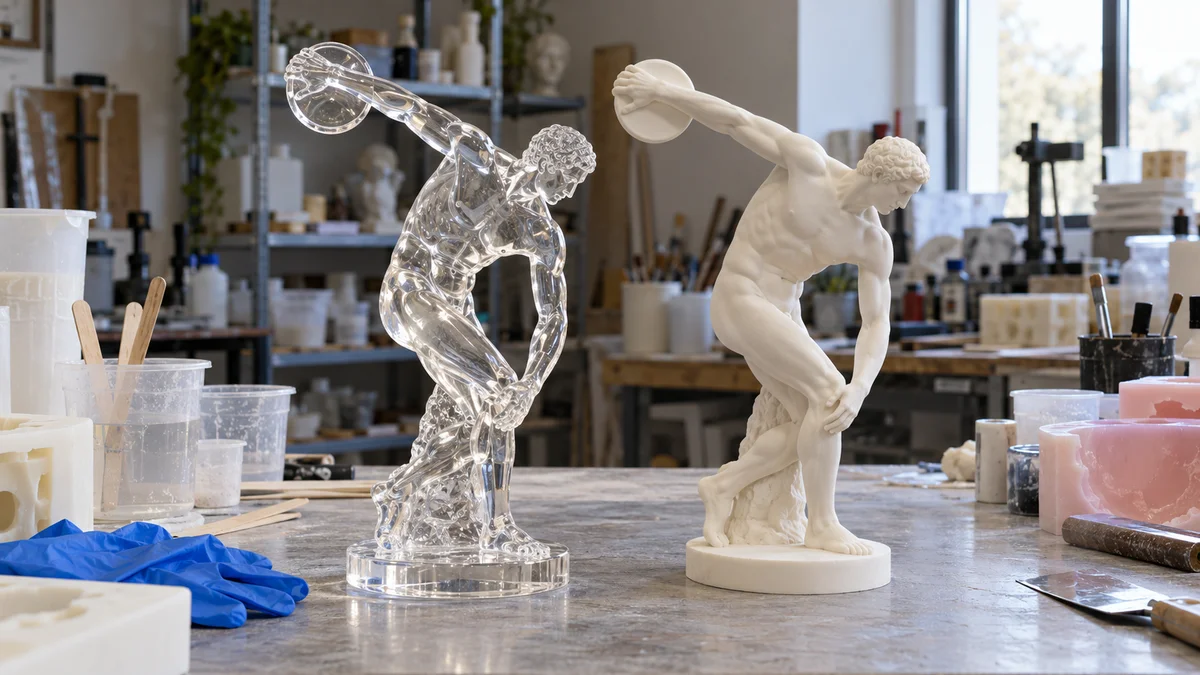
If the whole part is going to be painted, in the vast majority of cases the best option is polyurethane resin: it is very fluid, copies fine detail, demoulds in minutes, comes out in an opaque colour that works as a base for the paint and lets you pull many copies from the same mould in a single afternoon. Epoxy resin makes sense when you need transparency or translucency (a gem, an eye, a water or ice effect) or when you are making a one-off piece and prefer long, unhurried working times.
| Criterion (figure to be painted) | Polyurethane | Clear epoxy |
|---|---|---|
| Fine detail from the mould | Excellent (very low viscosity) | Good, but traps more bubbles in recesses |
| Time to demould | Minutes | Hours |
| Copies per mould per day | Many | One or two |
| Colour of the part | Opaque (white, ivory, black) or translucent amber | Transparent |
| Base for painting | Very good, flaws are visible before priming | Adequate, but you lose its advantage (transparency) |
| Weak point | Sensitive to moisture, short working time | Slow, more bubbles in fine detail |
Detail reproduction: which one copies the mould better
On a figure, the detail is in the small places: fingers, hair, skin textures, the rivets on a piece of armour or the lettering on a plaque. For the resin to reach those areas it has to be very fluid and must not trap air. Polyurethane casting resins have a very low viscosity, almost like water, and flow into the recesses of the mould on their own. That is why casting resins for reproductions and model making, such as Feropur PR55+E55 or SikaBiresin F38, are polyurethanes.
Epoxy also reproduces the mould surface well, but it is usually somewhat thicker and, above all, it cures slowly. That has a good side (bubbles have time to rise) and a bad side: in closed areas or upside-down sections of the mould, a bubble stuck to the wall has no way out and shows up as a hole right in the detail you wanted.
Shrinkage and parts that do not warp
In a replica, especially one with parts that fit together (an arm that goes into a shoulder, a base with a locating peg, a multi-part kit), shrinkage matters. Both families of casting resin have low shrinkage when used as the manufacturer indicates, so for figures and busts of normal size either of them will fit well.
Where there is a difference is heat. Fast polyurethane heats up as it cures and, in very thick castings, that heat can mark or distort the part; that is why large solid figures are best made hollow or with a slower resin, such as EasyFlo 90, which gives 5 minutes of working time and cures in 1-2 hours. The same happens with epoxy if you exceed the thickness each resin allows: a resin for thin layers poured into a thick block heats up, yellows or cracks. Always respect the maximum thickness on the technical data sheet.
Curing time and batch production
This is the factor that weighs most if you are going to make several copies. A rigid polyurethane resin such as Feropur PR55 WHITE gives about 2 minutes of working time and is ready in about 10 minutes; EasyFlo 60 gives 2.5 minutes of working time. With a single mould you can pull several copies in a row in one afternoon, which is essential if you make armies for wargaming, parts for a kit or orders of several units.
A clear epoxy such as ClearWater Epoxy for Jewellery gives about 30 minutes of working time and needs 8-10 hours to cure; even the fast version, ClearWater Super Fast, needs 1-2 hours and is designed for thin castings. For a one-off piece this is not a problem; for batch production, the mould is tied up for almost the whole day.
The trade-off with polyurethane is that you have to work fast: weigh the components before you start, have the mould ready and mix amounts you can pour within the stated working time.
How each one behaves when painted
This is the key to the decision. If the figure is going to be painted, the transparency of epoxy is no longer useful: the primer covers it with the first coat. You are paying (in money and in curing hours) for a property that will not be seen.
Polyurethane, on the other hand, comes out in an opaque, even colour that works in your favour:
- White or ivory (EasyFlo 60, Feropur PR55 WHITE, Feropur PR55+E55): bubbles, flash and seam lines are visible to the naked eye before priming, and light colours cover in fewer coats.
- Black (EasyFlo Black): useful for parts finished in dark or metallic tones, because a small chip does not reveal white underneath.
- Mass-tinted: with PolyColor Dyes or pigment paste you can cast the part already in its base colour, so that wear from handling does not reveal a different tone under the paint.
As for adhesion, both resins take paint well once cleaned and primed. The problem is almost never the resin itself, but the release agent residue left on the surface (we look at this further down).
When epoxy does make sense
Epoxy is not worse, it simply shines in a different kind of piece. Choose it when:
- Part of the figure has to be see-through: gems, crystals, eyes, a magic orb, an ice sword, water effects or translucent flames. Here it is not painted, or it is tinted with UltraColor translucent pigments.
- It is a one-off piece and you prefer 30 minutes of relaxed working time instead of a rushed 2 minutes.
- You are going to encapsulate something inside the replica, or it is a base or diorama with water.
The most common approach for figures with effects is to combine the two: the body in polyurethane, which is painted, and the transparent parts in epoxy, which are glued on afterwards. If you are looking for a middle ground, EasyFlo Clear is a translucent amber polyurethane that can be pigmented and used for cold casting with metal powder, with the fast times of polyurethane.
The mould: which silicone to use
For casting figures and replicas, whether in polyurethane or epoxy, the standard mould is made of silicone. A soft tin-cure (condensation) silicone is the most convenient option: it is tolerant of almost any original, is not inhibited by sulphur-containing modelling clays and demoulds easily thanks to its flexibility.
- EASYL 3520 (Shore A20): soft and easy to demould, ideal for detailed figures with the odd small undercut.
- Silastic 3481 (Shore A21): resistant to polyurethane, epoxy and polyester resins, and with several catalysts to adjust the working time.
If it is your first time, the Resin moulding kit includes EASYL 3520 silicone, Feropur PR55+E55 polyurethane resin, release agent and modelling clay in a single box. And if the figure has volume on all sides, you will be interested in our guide to the two-part silicone mould. To extend the life of the mould when you are going to pull many polyurethane copies, a compatible release agent such as Pol-Ease 2500 helps stop the resin from gradually wearing down the silicone surface.
How to prepare the part for painting
- Let it cure fully. Being able to demould does not mean the part has reached its final hardness. Respect the full curing time on the data sheet before sanding or painting.
- Remove flash and sprues. Cut off the pouring channels with a blade and sand the mould seam lines.
- Wash the part. Release agent residue is the number one reason paint does not adhere or peels off. Wash with warm soapy water, or wipe with a cloth and isopropyl alcohol, and let it dry.
- Prime. A primer suitable for resin, such as Vallejo spray primer, in thin coats. After priming you will see the remaining defects: this is the time to touch them up with filler or sandpaper.
- Paint. Acrylics, airbrush or brush, just as you would with any miniature or replica.
Common mistakes
- Polyurethane and moisture. Polyurethane reacts with water: a damp mould, a badly closed container or a very humid day produce foam, bubbles or a tacky surface. Work with a completely dry mould and close the containers right after using them.
- Mixing by eye. Both families require the exact ratio. A badly measured 1:1 polyurethane ends up soft or brittle; a badly measured epoxy stays tacky for days.
- Mixing too much polyurethane. If you prepare more than you can pour in 2-3 minutes, it gels in the cup.
- Pouring epoxy into a thick block. If the resin is not designed for thick castings, the heat of the reaction can yellow or crack it. For large thicknesses there is ClearWater Deep Pour.
- Painting without washing. A freshly demoulded part looks clean, but it has a film of release agent that will make the paint peel off with use.
Which resin to choose for your project
| Project | Recommended resin |
|---|---|
| Wargaming miniatures, small parts with lots of detail | Feropur PR55+E55 (80 s working time, demould in 8 min) |
| Scale models and multi-part model kits | SikaBiresin F38 (2 min working time, demould in 20-25 min) |
| Figures and busts in batches, white base for painting | Feropur PR55 WHITE or EasyFlo 60 |
| Larger figures or beginners who need more leeway | EasyFlo 90 (5 min working time) |
| Replicas in dark or metallic tones | EasyFlo Black |
| Cold casting and translucent pigmented parts | EasyFlo Clear |
| Gems, eyes, transparent water or ice effects | ClearWater Epoxy for Jewellery or ClearWater Super Fast for thin parts |
If you want to see all the options, you have the full category of polyurethane resins and the one for clear epoxy resins. And if the figure breaks later on, we explain how to repair broken figures with epoxy adhesive.
Frequently asked questions
Which resin is best for figures I am going to paint?
In most cases, polyurethane resin. It copies detail very well, demoulds in minutes and comes out in an opaque colour that works as a base for the paint. Resins such as Feropur PR55+E55 or EasyFlo 60 are designed for exactly that.
Can epoxy resin be painted?
Yes. Once fully cured, washed and primed, epoxy takes acrylic paint just like polyurethane. The thing is that, if you paint it all over, you lose its main advantage, transparency, and you have also waited hours of curing for each copy.
Why do I get bubbles or foam in my polyurethane resin?
Almost always because of moisture: polyurethane reacts with water. Check that the mould is completely dry and that the containers are properly closed after each use, and avoid working in very humid environments. Pouring in a thin stream from a certain height also helps to break the bubbles in the mix.
Which silicone should I use for a figure mould?
A soft tin-cure silicone is the most convenient option for casting resin. EASYL 3520 (Shore A20) is very easy to demould, and Silastic 3481 is formulated to withstand polyurethane, epoxy and polyester resins over many castings.
Can I combine polyurethane and epoxy in the same figure?
Yes, and it is the usual approach for figures with effects. The body is cast in polyurethane and painted, and the transparent parts (gems, eyes, water or ice effects) are cast separately in an epoxy such as ClearWater Epoxy for Jewellery and glued on at the end.
Why is the paint peeling off my resin figure?
Usually because of release agent residue on the surface. Before priming, wash the part with warm soapy water or wipe it with a cloth and isopropyl alcohol, let it dry and apply a primer suitable for resin in thin coats.
Comments (0)