
Shopping Cart
- Feroca
- Cosplay
- 0 likes
- 2188 views
- 0 comments
The EasyGel FX range from Feroca is a family of platinum silicones designed for special effects prosthetics, fine-detail moulds, and hyperrealism pieces. Each product has a different Shore hardness and a working time adapted to different stages of the process. In this article we explain what each one does, how to choose the right hardness, and how to use the Gloomer Deadener and DYE PLAT pigments to customise the result.
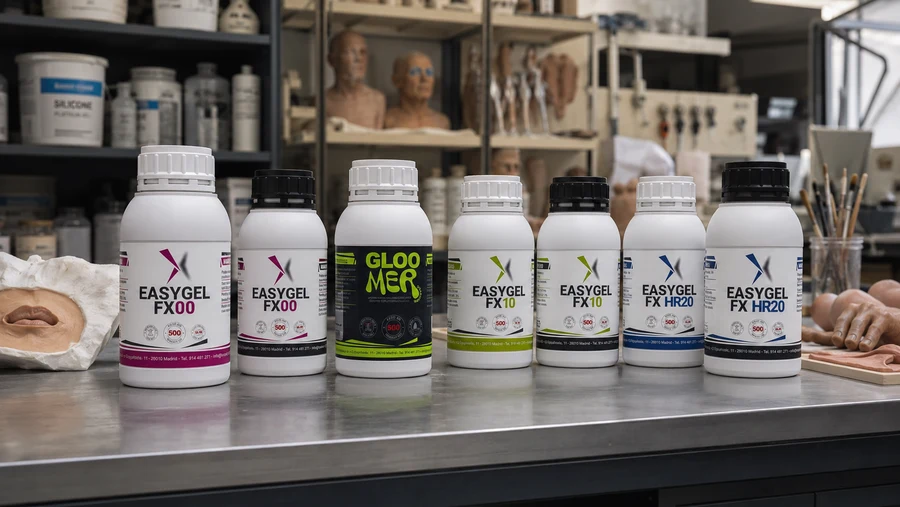
The EasyGel FX range
EasyGel FX is the prosthetics silicone range that Feroca manufactures and distributes exclusively. They all share the same base: two-component platinum silicone, 1:1 mix by weight, solvent-free, translucent, and compatible with the Gloomer Deadener and DYE PLAT pigments. The difference between models lies in the Shore hardness, working time, and mechanical resistance.
The aim of the range is to let you choose exactly the texture you need for each piece: from ultra-thin eyelids and blending edges (FX00) to tear-resistant mould shells (FX HR20).
Quick comparison of the 4 silicones
| Product | Shore | Working time | Cure time | Main use |
|---|---|---|---|---|
| EasyGel FX00 | 00-30 | 35 min | 1 h | Ultra-soft prosthetics, blending edges, Reborn |
| EasyGel FX10 | A10 | 35 min | 1 h | FX prosthetics, fine-detail moulds |
| EasyGel FX25 | A25 | 50 min | 16 h | High-definition moulds, firmer prosthetics |
| EasyGel FX HR20 | A20 | 10 min | 25 min | Fast moulds, high tear resistance |
EasyGel FX00 — the softest
EasyGel FX00 is the softest silicone in the range, with a Shore 00-30 hardness. It's ideal for any piece where you need a texture that mimics human skin as faithfully as possible: eyelids, lips, blending edges that disappear onto the actor's skin, and Reborn dolls.
With 35 minutes of working time and a 1-hour cure, it lets you cast at a relaxed pace and demould on the same working day. Its translucency makes it easy to pigment in mass with DYE PLAT Flesh Tones to achieve convincing skin tones.
EasyGel FX10 — general prosthetics use
EasyGel FX10 is the most versatile product in the range and the most widely used for medium-sized FX prosthetics: noses, ears, foreheads, scars, and wounds. Shore A10, same timings as the FX00 (35 min working time, 1 h cure), also translucent.
It can be combined with Gloomer Deadener to lower the hardness even further at the edge areas, creating a piece with a firmer centre and extremities that blend into the skin without leaving a mark. It's also a great silicone for fine-detail moulds when you don't need the tear resistance of the HR20.
EasyGel FX25 — for moulds and greater durability
EasyGel FX25 has a Shore A25 hardness and a working time of 50 minutes, which makes it particularly useful for high-definition moulds where you need more time to ensure the silicone penetrates every detail of the sculpture. Its full cure time is 16 hours.
It's also used for prosthetics that require more body: large-scale pieces, applications that will undergo a lot of movement or tension throughout the day, or full-body prosthetics. The additional hardness compared to the FX10 helps the piece hold its shape without deforming from the actor's body heat.
EasyGel FX HR20 — fast cure
EasyGel FX HR20 is the go-to product when time is a critical factor: just 10 minutes of working time and 25 minutes to cure. This makes it indispensable on shoots with tight deadlines, in production workshops, or whenever you need to demould quickly to repeat the casting.
In addition to its fast cure, the HR20 has superior tear resistance compared to the rest of the range, making it especially well-suited for moulds that will be used many times over. Shore A20, translucent like the rest of the family.
Gloomer Deadener — softening the silicone
The Gloomer Deadener is a plasticiser specifically formulated for the EasyGel FX range. It's added to the mix of parts A and B before catalysing, and reduces the Shore hardness of the final result depending on the percentage used (10–50% of the total weight of the mix).
The main use is to create hardness gradients within a single prosthetic: mixing FX10 with Gloomer for the edges that touch the actor's skin, and using FX10 without Gloomer for the central body that needs to hold its shape. It's also used to soften the FX25 down to intermediate textures without switching products.
Unlike other deadeners on the market, the Gloomer is formulated not to bleed out (it leaves no greasy residue on the surface of the piece), which makes it easier to apply makeup and medical adhesives such as Pros-Aide.
DYE PLAT pigments — colouring from within
The DYE PLAT line consists of highly concentrated liquid pigments formulated for platinum and tin silicones. They're mixed directly into the silicone before catalysing, distributing colour evenly throughout the entire mass of the piece. There are three lines depending on the application:
DYE PLAT Flesh Tones
The essential line for human skin prosthetics. It includes a palette of skin tones, from the lightest to the darkest, designed to be mixed together to achieve the actor's exact shade. A single drop colours large quantities of silicone; the very high concentration allows you to fine-tune opacity with precision.
DYE PLAT FX
Specific colours for special effects: blood reds, vein blues, pus yellows, necrosis greens. These are the pigments used to mass-colour wounds, burns, creature prosthetics, and any piece that needs a non-skin colour. They're also useful for adding veins and subcutaneous translucency when mixed at very low doses with the Flesh Tones.
DYE PLAT Fantasy
Vibrant colours for cosplay, theatre, and fantasy character work: blues, greens, purples, golds, saturated reds. Designed for creature skins, elves, vampires, aliens, and any non-human character. They can be used on their own or mixed with the FX line to achieve intermediate colours.
How to choose based on your project
- First prosthetic or beginner project: EasyGel FX10 + DYE PLAT Flesh Tones
- Ultra-thin edges that disappear onto the skin: EasyGel FX00 on its own, or FX10 with Gloomer at 30–40%
- Reusable high-definition moulds: EasyGel FX25
- Series production or shoots with tight deadlines: EasyGel FX HR20
- Creature prosthetics or fantasy cosplay: FX10 or FX25 + DYE PLAT Fantasy
- Wound, burn, or necrosis effects: FX10 + DYE PLAT FX
Frequently asked questions
What's the difference between EasyGel FX10 and FX25?
The main difference is Shore hardness: A10 versus A25. The FX10 is softer and is used primarily for the silicone casting (the final prosthetic), while the FX25 is somewhat firmer and is particularly useful for high-definition moulds or prosthetics that need to hold their shape better. The working time is also longer with the FX25 (50 min versus 35 min), which gives you more room to distribute the silicone evenly in complex moulds.
Can I use Gloomer Deadener with any EasyGel FX silicone?
Yes. The Gloomer Deadener is specifically formulated for the entire EasyGel FX range (FX00, FX10, FX25 and FX HR20). It's added to the mix of parts A and B before catalysing. The recommended ratio is between 10% and 50% of the total weight of the mix; above 50%, the silicone may lose mechanical resistance and become difficult to demould.
When should I add the DYE PLAT pigments?
The DYE PLAT pigments are mixed into the silicone before adding the catalyst (part B). The usual process is: mix the pigments into part A, then add part B and mix until homogeneous. You can also pigment part A only and add part B just before pouring. Don't add the pigments after mixing A and B together, as the catalyst will already be activating and there will be less time to distribute the colour evenly.
Can EasyGel FX HR20 be used for prosthetics as well as moulds?
Yes, although its most common use is for moulds due to its tear resistance and fast cure. For prosthetics, the 10-minute working time is very tight if you need to make a complex casting or work on distributing the silicone. It's better suited to simple prosthetics or series production where you've already mastered the process and can work quickly.
How much silicone do I need for a nose prosthetic?
For a standard nose prosthetic, you'll typically use between 50 g and 100 g of mixed silicone (parts A and B combined). If it's your first time and the mould is straightforward, 100 g gives you enough leeway to fill the mould with some to spare. For moulds with a lot of detail or larger pieces (forehead, ear), the amount can go up to 200–300 g.
Are DYE PLAT pigments compatible with tin silicones?
Yes. The DYE PLAT pigments are formulated to be compatible with both platinum silicones (such as the entire EasyGel FX range) and tin silicones. The required concentration may vary slightly depending on the type of silicone, but the process is the same: add before catalysing and mix until you achieve a uniform colour.
Comments (0)