Shopping Cart


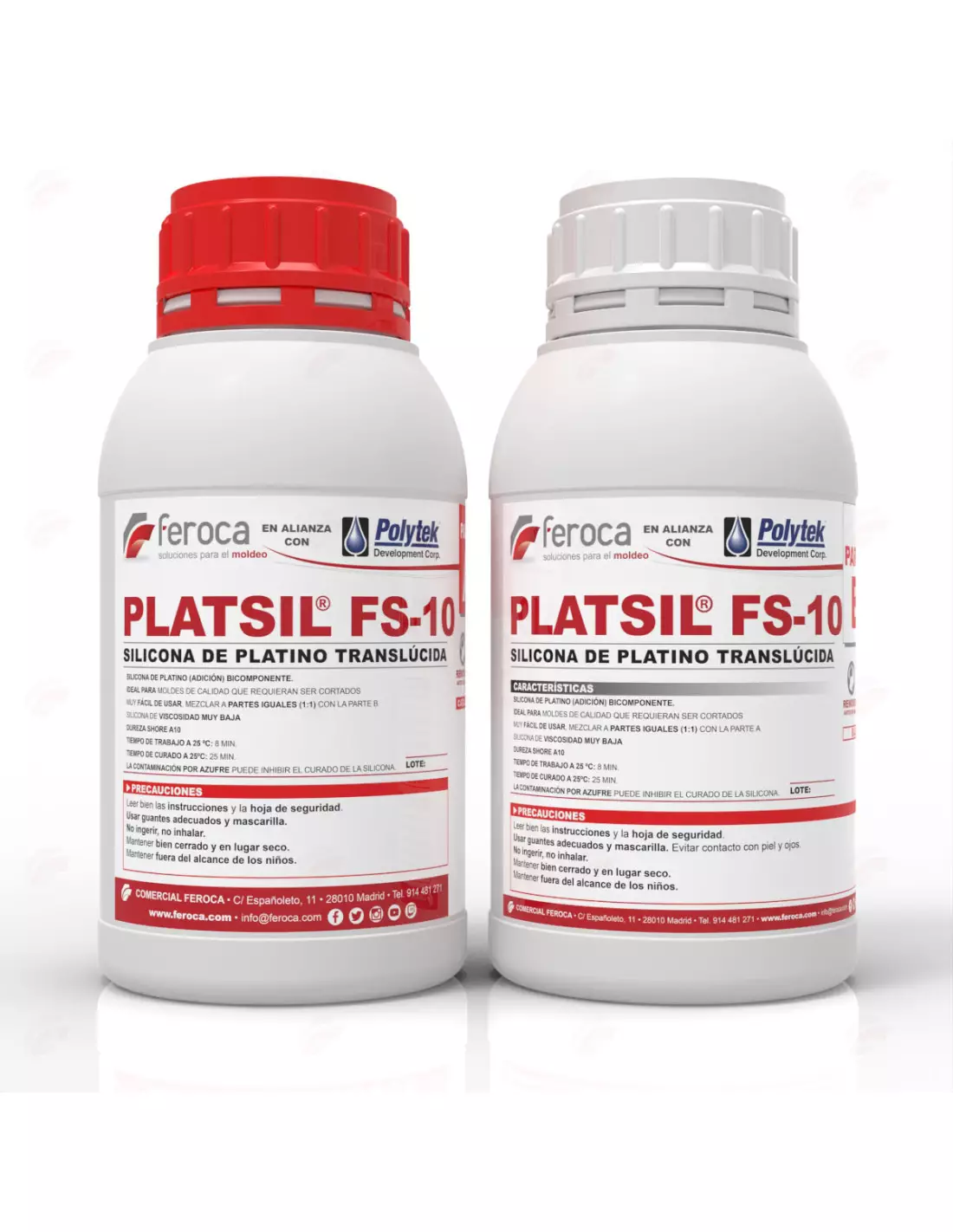
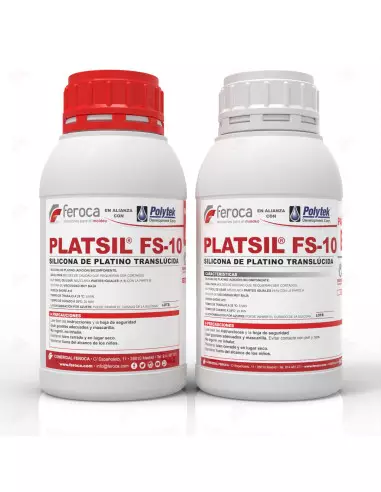
PlatSil FS-10 -Platinum Silicone-
290040101
€42.00
50,82 € Tax incl.
50,82 € Tax incl.
Translucent platinum silicone Shore A13, 1:1 mix by weight and volume, 8 min working time and cure in 25 min. High tear resistance.
PlatSil FS-10 is a translucent platinum (addition) silicone with Shore A13 hardness, formulated to deliver exceptional tear resistance along with a very fast cure cycle. It mixes in equal parts by weight and by volume (1A:1B), simplifying workshop use and reducing errors. Its translucent nature once cured makes it a particularly practical choice for molds requiring post-cure cutting or parts with complex geometries where verifying complete fill is essential.
Technical specifications
| Parameter | Value |
|---|---|
| Type | Platinum silicone (addition) |
| Color | Translucent white |
| Shore Hardness | A13 |
| Mix ratio by weight | 100A : 100B |
| Mix ratio by volume | 100A : 100B |
| Working time (25 °C) | 8 min |
| Cure time (25 °C) | 25 min |
What it's used for
PlatSil FS-10 is a general-purpose casting silicone aimed at professionals and workshops that need short cycle times without sacrificing mold durability. Its translucency and pre-gel behaviour — which prevents sagging — also make it suitable for brush application when thickened with a thixotropic agent. Common applications:
- Casting molds for reproducing decorative, sculptural and craft pieces
- Molds for complex parts where translucency allows verification of complete fill
- Molds intended to be cut after curing, as the model remains visible through the silicone
- Short and medium production runs where a fast cycle between castings is required
- Brush application after thickening with PlatThix for layer-built coating molds
- Special effects and low-hardness prosthetics that do not require ultra-soft Shore values
- Molds for polyurethane resins, epoxy resins and plaster
How to use it
- Prepare the model. Make sure the surface is clean, dry and free of inhibiting contaminants (sulfur, latex, uncured epoxy, vinyl). Apply a release agent if the model material requires it.
- Weigh or measure the components. Mix 100 parts of component A with 100 parts of component B, both by weight and by volume. Use a precision scale for best results.
- Mix for 2–3 minutes. Stir slowly and evenly with a spatula, scraping the sides and bottom of the container thoroughly to avoid uncatalyzed areas.
- Degas if you have a vacuum chamber. A brief degassing (1–2 min) removes bubbles introduced during mixing and improves the surface definition of the mold.
- Pour or apply within the first 8 minutes. Pour the silicone from a low point in the mold so air rises in a controlled manner. If brush-applying, lay the first coat immediately.
- Allow to cure without moving the mold. At 25 °C full cure occurs in approximately 25 minutes. Do not force demolding ahead of time.
- Demold carefully. The high tear resistance of PlatSil FS-10 allows complex demolds without risk of tearing, but work with smooth, even movements.
Warning: cure inhibition in platinum silicones
Platinum (addition) silicones like PlatSil FS-10 are sensitive to certain contaminants that can partially or completely inhibit curing, leaving the surface tacky or uncured. The main inhibitors are:
Platinum (addition) silicones like PlatSil FS-10 are sensitive to certain contaminants that can partially or completely inhibit curing, leaving the surface tacky or uncured. The main inhibitors are:
- Clays and oil-based clays containing sulfur (most conventional modeling clays)
- Tin silicones (condensation) and parts made with them
- Latex in any form (gloves, molds, parts)
- Polyester and epoxy resins that are not fully cured
- Vinyl and PVC
- Some paints and varnishes containing amines or tin compounds
- Petroleum jelly and some silicone-based release agents that are not compatible
Usage tips
Temperature and working time
The 8-minute working time is measured at 25 °C. At higher temperatures curing accelerates and you will have less handling time; below 20 °C the process slows down. In summer or in warm workshops, slightly chill the components before mixing to gain extra time. Never heat the components to speed up curing: this increases the risk of bubbles and reduces surface definition.
Thickening for brush application
PlatSil FS-10 is a casting silicone, but it can be made brushable by adding PlatThix (thixotropic agent for platinum silicones) after mixing the two components. The thixotropic agent only modifies viscosity and does not alter cure time. Add it gradually until the desired consistency is reached, stirring gently to avoid incorporating air.
Storage and shelf life
Keep containers tightly closed in a cool, dry place away from heat sources and potential contaminants. Once opened, component B (platinum catalyst) is especially sensitive to cross-contamination: use clean, dedicated spatulas for each component. If the containers have been open for a long time and you notice that the silicone is not curing correctly within the stated times, discard the batch and use fresh material.
Frequently asked questions
What materials inhibit the curing of a platinum silicone?
Platinum silicones like PlatSil FS-10 may not cure correctly if they come into contact with sulfur (present in many modeling clays), latex, uncured epoxy, fresh polyester resins, vinyl, tin silicones, some amine-containing paints and petroleum jelly. When in doubt, always run a compatibility test with a small amount before making the final mold.
Can I brush this silicone or is it only for casting?
PlatSil FS-10 is primarily formulated for casting, but it can be thickened by adding PlatThix for brush application. The thixotropic agent is incorporated after mixing components A and B and does not modify cure time, only viscosity.
Is it compatible with already-made tin silicone molds?
Not directly. Platinum silicone will not cure on tin silicone surfaces because it becomes inhibited. If you need to use a counter-mold or mold box made from condensation silicone, apply a sealer coat or always run a prior compatibility test.
Can I use this silicone to make Food Safe molds?
Cured platinum silicones are generally inert and many carry FDA certification, but you should check the specific technical data sheet for PlatSil FS-10 to confirm its suitability for food contact. If you need certified Food Safe grade, consult Feroca before using it for that purpose.
How long do I need to wait before demolding?
At 25 °C, PlatSil FS-10 reaches full cure in approximately 25 minutes. However, for demanding molds or parts with complex geometry, it is advisable to wait 30 to 40 minutes before demolding to ensure the silicone has developed its full mechanical strength.
Can I use latex gloves when working with platinum silicones?
No. Latex is one of the most common inhibitors of platinum silicones. If you use latex gloves and dip them into the mix or touch the mold, you can inhibit curing in the contact areas. Always use nitrile or sulfur-free vinyl gloves, and check that they are also compatible with the silicone.
Can the working time be extended to allow more handling time?
It is possible to use a specific retarder for platinum silicones, but the maximum recommended proportion is 3% of the total mix weight. Exceeding that amount may compromise the cure and the mechanical properties of the resulting mold.
What is the difference between this silicone and others of similar hardness?
PlatSil FS-10 stands out for its fast cycle (cured in 25 minutes) and its exceptional tear resistance, making it virtually tear-proof during complex demolds. Compared to other Shore A13 silicones such as Silastic 3481 (condensation), PlatSil FS-10 offers greater dimensional stability, no cure by-products and the translucency characteristic of platinum silicones.
Video tutorials
Translucent Silicone Mold · PlatSil FS20
Silicone Mask · PlatSil FS20 ·
FS T20 VS TRANSIL 20 v1
- Color
- Translucent White
- Working Time
- 8min
- Curing Time
- 25min
- Shore Hardness
- A13
- Volume Mixing Ratio
- 100A:100B
- Mixed Weight Ratio
- 100A:100B
No reviews
Tap to zoom