Shopping Cart


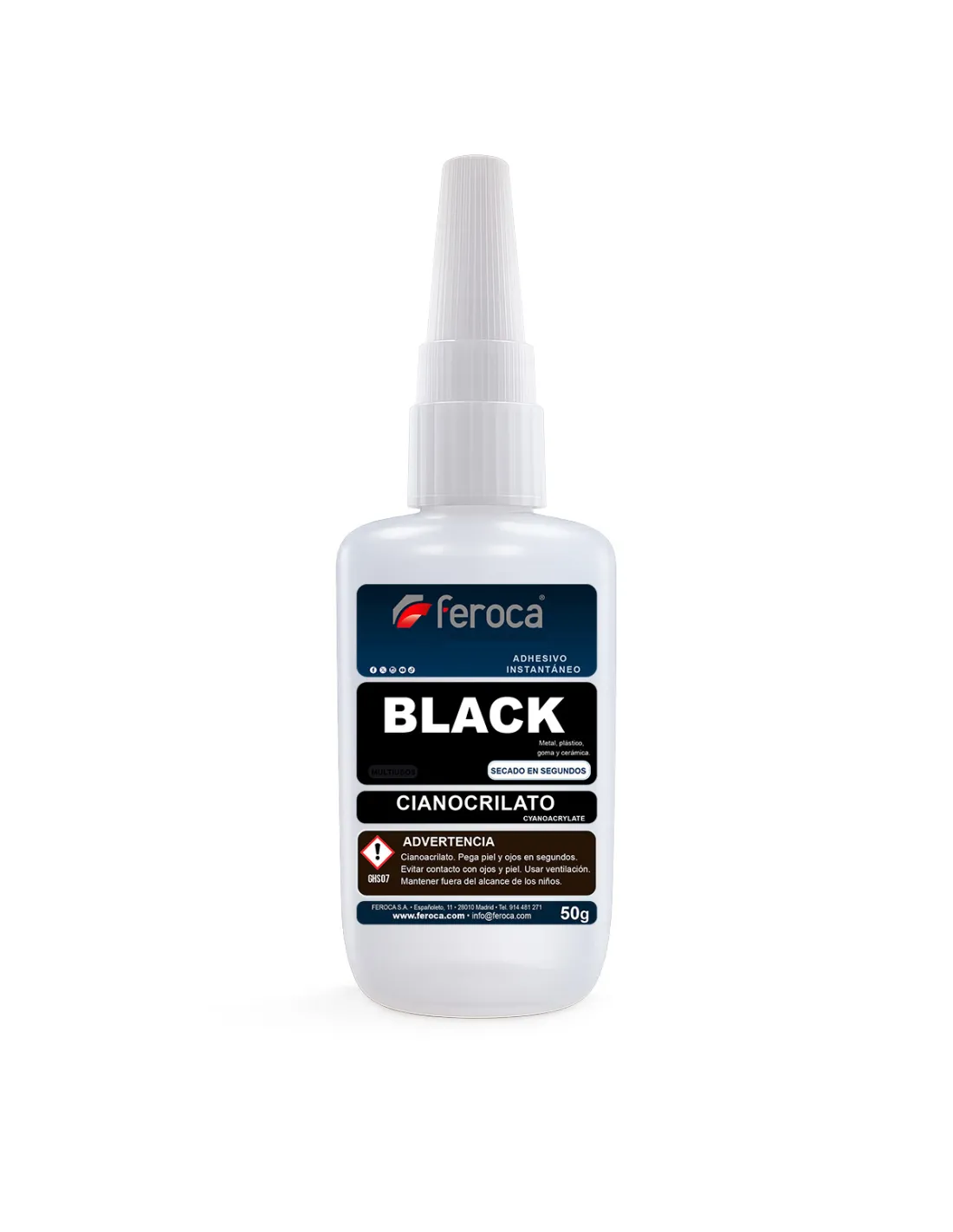
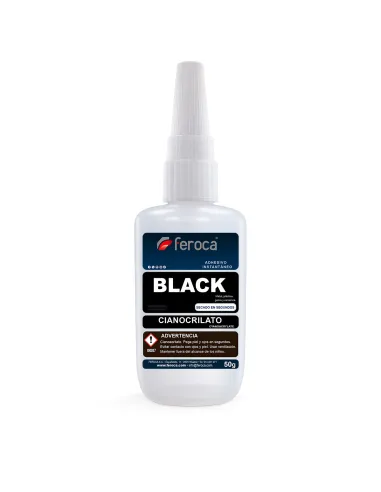
Ciano Black 50g
406070000
€10.00
12,10 € Tax incl.
12,10 € Tax incl.
Black cyanoacrylate adhesive for metal, plastic and rubber. Viscosity 245-325 cps. Fixture in 5-20 s. 50 g.
Ciano Black is a black cyanoacrylate adhesive with medium-high viscosity, developed for fast and strong bonding of metals, plastics and low-porosity rubbers. The black pigmentation makes it invisible in applications on dark materials or visible black joints.
Technical specifications
| Parameter | Value |
|---|---|
| Colour | Black |
| Viscosity | 245 – 325 cps |
| Fixture time | 5 – 20 seconds |
| Full cure | 24 hours |
| Maximum gap | 0.15 mm |
| Presentation | 50 g |
| Container type | Dispensing needle |
What it is used for
Its combination of black colour and medium-high viscosity makes it ideal for industrial applications where joint aesthetics matter and the substrate has low porosity. It is particularly suitable for:
- Bonding metal, steel, aluminium and alloys
- Bonding rigid plastic parts (ABS, acrylic, PVC) in black or dark colours
- Gluing rubber, neoprene and synthetic rubbers
- Repairs of machinery parts where the joint must be invisible
- Footwear and leather goods industry on dark materials
How to use it
- Prepare the surfaces: degrease and dry the surfaces to be bonded. Remove rust, loose paint or contaminants with a suitable solvent and allow to dry completely.
- Apply the adhesive: deposit a minimal amount of Ciano Black onto one of the surfaces using the dispensing needle. A thin, even coat is sufficient; excess slows curing and may cause white staining.
- Join the parts: bring both surfaces together immediately and press firmly for 5–20 seconds until initial fixture.
- Hold the position: although initial fixture occurs within seconds, avoid subjecting the joint to significant stress until at least 1 hour has passed.
- Clean excess: remove adhesive residue immediately with Limpiaciano before it cures, as once polymerised cyanoacrylate is very difficult to remove without a specific solvent.
- Full cure: leave undisturbed for 24 hours without stressing the joint to achieve maximum strength. In cold environments or low humidity, curing may be slower.
- Storage: close the bottle after each use, store it upright in a cool, dry place away from direct light and moisture.
Caution: cyanoacrylate adhesives bond instantly to skin and mucous membranes. Work with nitrile gloves and in a well-ventilated area. In case of eye contact, rinse with plenty of water and consult a doctor. Do not inhale vapours generated during curing. Keep the product out of the reach of children.
Usage tips
The dispensing needle: precision above all
The needle dispenser on Ciano Black allows you to deposit the adhesive exactly where needed, without wasting product or staining adjacent areas. To make the most of this advantage, apply the adhesive with slow, controlled movements and keep the needle perpendicular to the surface. If the needle becomes blocked between uses, clean the tip with a dry cloth before replacing the cap. Never insert objects into the needle to clear a blockage; replace it if it is clogged.
Black colour as a coverage indicator
Unlike transparent cyanoacrylates, the black colour of Ciano Black makes it easy to see how much adhesive has been applied and how it is distributed across the surface. Use this advantage to check that the coat is even and that there are no uncovered areas before joining the parts. A uniform distribution ensures a joint with consistent strength across its entire surface, avoiding localised weak spots.
Compatibility with dark materials and matte finishes
On dark materials with a matte finish (dyed leather, black rubber, dark ABS), Ciano Black is virtually imperceptible once cured. To ensure the joint is invisible, carefully clean any excess from the edges before curing with a dry cloth, as cured cyanoacrylate can create a slight sheen on matte surfaces. If working with leather goods or footwear, apply the adhesive from inside the fold so the joint remains completely hidden.
Frequently asked questions
Does the black colour of Ciano Black affect its strength?
No. The black pigmentation is aesthetic and does not alter the adhesive properties or mechanical strength of the cyanoacrylate. The base formulation is identical to that of a standard medium-high viscosity cyanoacrylate; only the black pigment has been added to improve joint aesthetics in applications on dark materials.
Does it bond rubbers and soft elastomers?
Yes, with good adhesion on most synthetic rubbers (neoprene, EPDM, nitrile). On silicone rubbers, the adhesion of all cyanoacrylates is very limited, as silicone has a very low surface energy that prevents the adhesive from wetting correctly. For silicone, a specific adhesive or prior surface treatment is recommended.
Can it be used outdoors or in humid environments?
Cyanoacrylate has moderate resistance to moisture once cured, but is not suitable for prolonged immersion or continuous outdoor exposure. For outdoor applications with ongoing exposure to water or UV rays, polyurethane or epoxy structural adhesives are recommended, as they offer significantly superior environmental resistance.
When to use Ciano Black versus Ciano Flexible?
Ciano Black produces a rigid joint with high mechanical strength, ideal for low-porosity materials where joint aesthetics matter and the substrates will not flex in service. Ciano Flexible produces an elastic joint that absorbs vibrations and impacts, more suitable when substrates may move, bend or be subjected to repeated dynamic stresses.
How do I remove excess adhesive or debond a joint?
Cured cyanoacrylate can be softened with acetone or with Limpiaciano, specifically formulated for this purpose. Apply the solvent to the joint area, allow it to act for a few minutes and carefully separate the parts. Bear in mind that acetone may attack certain plastics and surface finishes, so always test on a hidden area before applying. For skin, use warm water and soap or vegetable oil; never forcibly tear bonded parts apart.
How long does the bottle last once opened?
Once opened, shelf life depends on storage. Close the bottle tightly after each use and store it upright in a cool, dry place away from moisture and direct light. Under optimal conditions, an opened bottle can retain its properties for several months. If the adhesive has gelled or flows with difficulty through the needle, it should no longer be used.
No reviews
Tap to zoom