Shopping Cart



Alamo 70
210073001
€5.00
6,05 € Tax incl.
6,05 € Tax incl.
Alamo 70 plaster for ceramic slip casting moulds. Plaster/water ratio 1.65-1.73 kg/l, Brinell hardness 480 kg/cm², final setting 28-30 min.
Alamo 70 is a calcium sulfate hemihydrate gypsum specially formulated for the manufacture of slip casting moulds in the ceramic industry. Its high Brinell hardness (480 kg/cm²) and controlled setting expansion make it a solid reference for ceramic workshops that need precise and durable moulds.
Technical specifications
| Parameter | Value |
|---|---|
| Chemical base | Calcium sulfate hemihydrate |
| Colour | White |
| pH | ≈ 7 |
| Recommended plaster/water ratio | 1.65 – 1.73 kg of plaster per 1 litre of water |
| Setting start | 10 – 12 minutes |
| Setting end | 28 – 30 minutes |
| Brinell hardness | 480 kg/cm² |
| Setting expansion | 0.20 % |
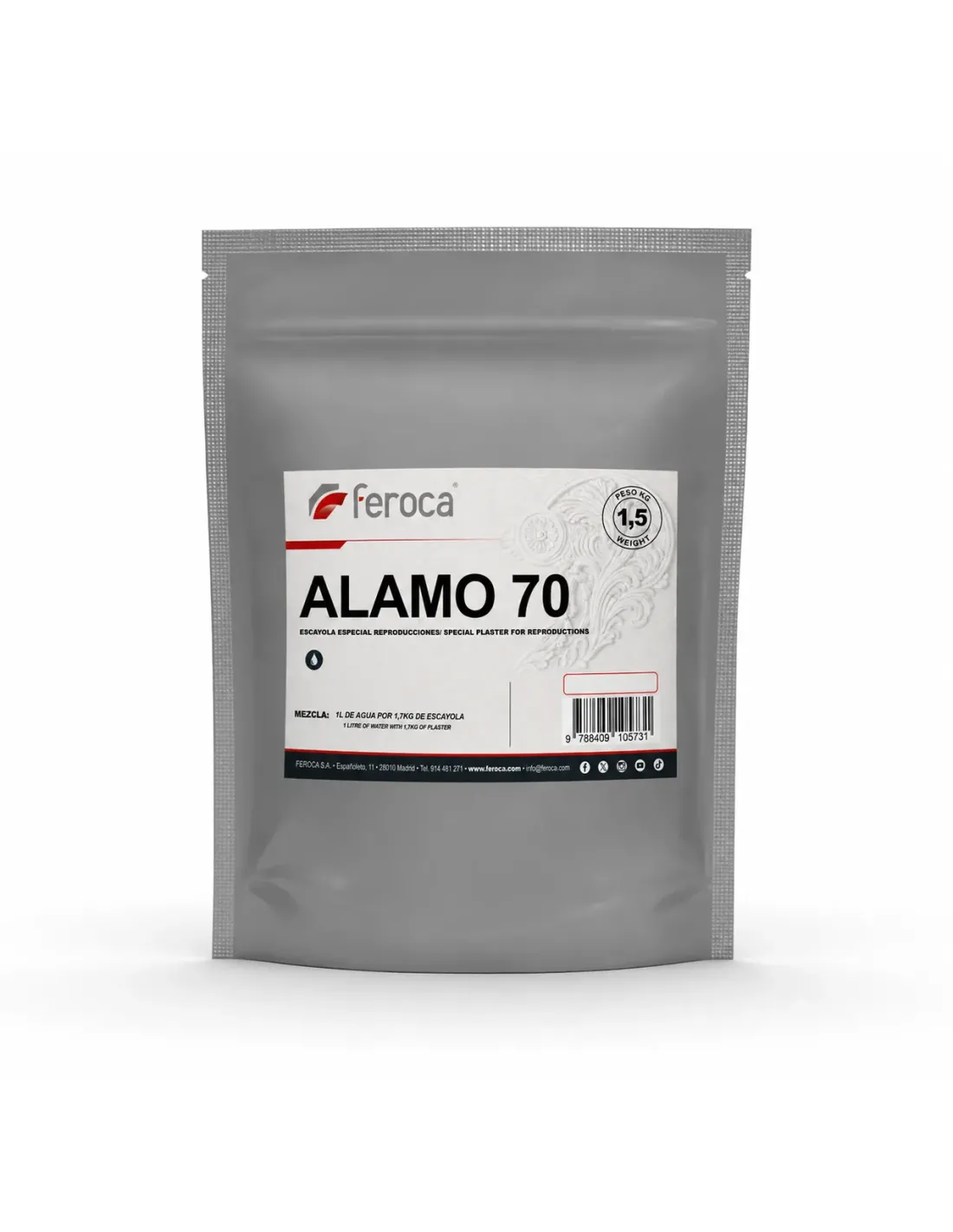
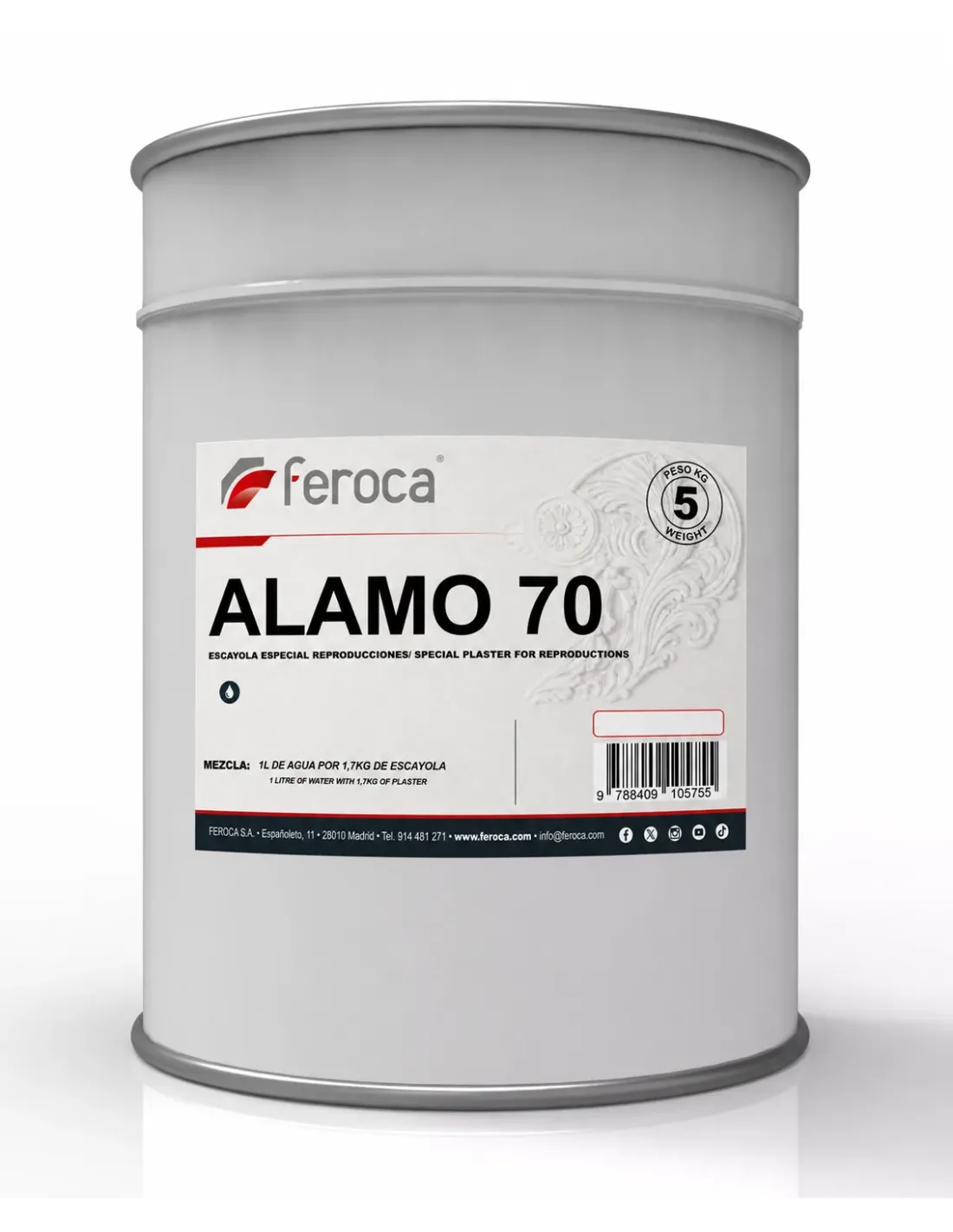
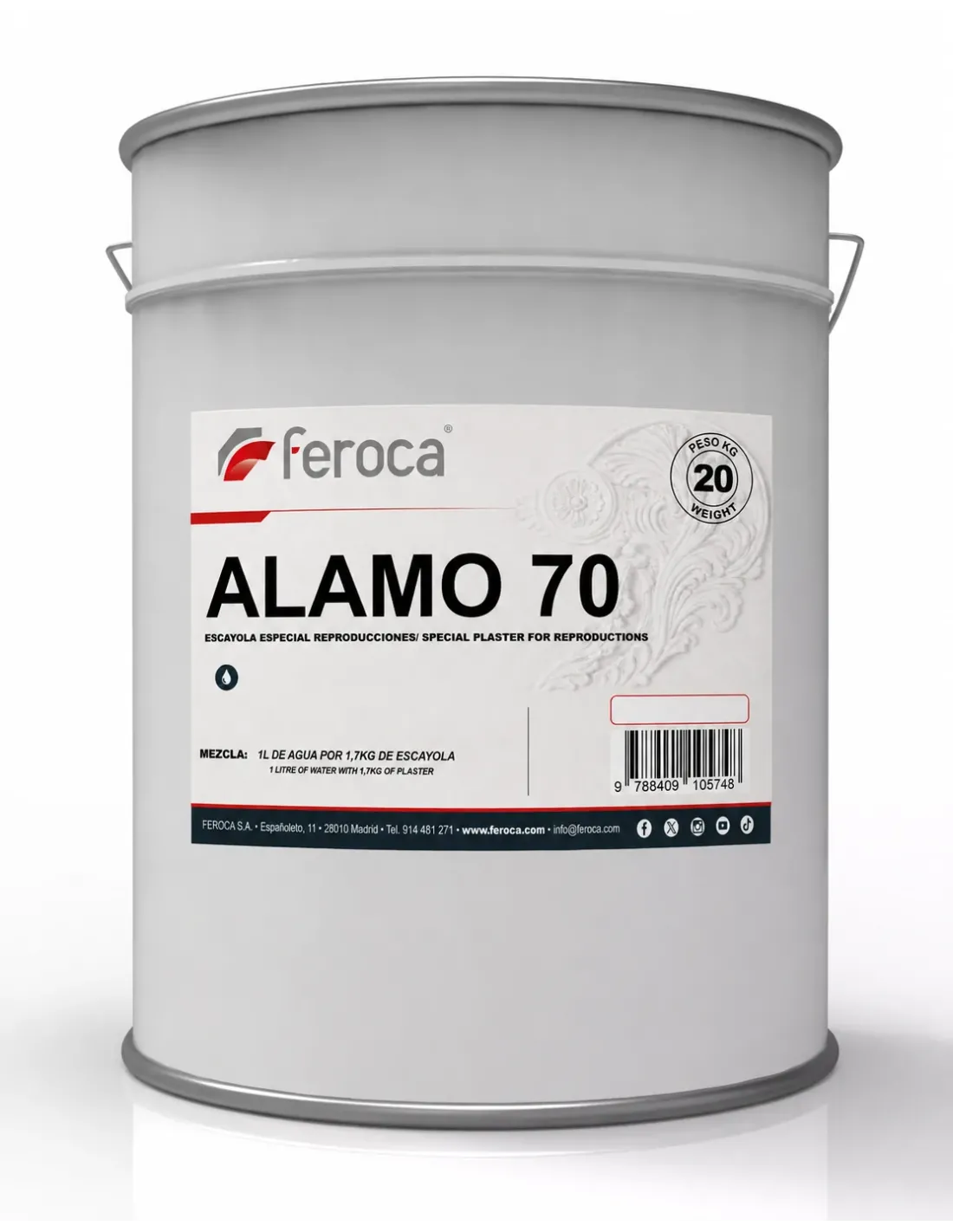
| Available formats | 1.5 kg / 5 kg / 20 kg |
What it is used for
Alamo 70 is designed primarily for the ceramic industry, although its strength/working time ratio makes it useful in other contexts where absorbent, high-hardness moulds are required:
- Manufacture of slip casting moulds for ceramic pieces (tableware, sanitaryware, figures)
- Reproduction of master moulds in artisanal and industrial ceramic workshops
- Production of counter-moulds and rigid shells for silicone moulds
- High dimensional precision castings and copies
- Prototyping and reproduction of pieces in special effects and scenography workshops
How to use it
- Prepare the mould or formwork and make sure all surfaces are clean and properly released with release wax.
- Measure the water first: work with a ratio of 1.65 – 1.73 kg of Alamo 70 per litre of water. For greater strength, use less water (closer to 1.73 kg/l), but bear in mind that working time will be shorter.
- Sprinkle the plaster over the water evenly without stirring. Allow it to saturate for 1-2 minutes.
- Mix with gentle, continuous movements until a smooth, lump-free paste is obtained. Avoid incorporating air.
- Pour the mixture into the mould before the 10-12 minute setting start time has elapsed. Tap the mould lightly to remove bubbles.
- Leave to set without moving. Final setting is complete between 28 and 30 minutes.
- Demould carefully once the piece has reached room temperature and shows no residual heat. Allow to dry completely before using the mould for slip casting.
Warning: Airborne dust is generated during mixing. Work in a ventilated space and wear a dust mask (FFP2 recommended) to avoid inhaling calcium sulfate particles. Avoid prolonged contact with eyes.
Usage tips
Control the water/plaster ratio according to use
The plaster/water ratio is the parameter that most influences the final result. With less water (1.73 kg/l) you obtain greater hardness and strength, ideal for moulds that will undergo many casting cycles. With more water (1.65 kg/l) the mix is more fluid and manageable, with a longer pouring time, suitable for moulds with complex geometry. Always weigh the materials; do not estimate by eye.
The right release agent for plaster on plaster
When making a shell or counter-mould of plaster over a piece also made of plaster, use release wax, not spray release agents formulated for rubber or resin. Apply several coats allowing each to dry in between, then buff. An unsuitable release agent can cause the two halves to bond permanently.
Drying before first use in ceramic slip casting
A freshly set mould still contains a lot of residual moisture. Before using it for slip casting, allow it to dry at room temperature for at least 24-48 hours or in an oven at low temperature (max. 50 °C). A damp mould absorbs slip poorly and can produce pieces with surface defects or very long casting times.
Frequently asked questions
What difference does using more or less water in the mix make?
With less water, the final hardness and strength of the mould increase, but the time available to pour the mixture is shorter. With more water you have greater fluidity and more working time, but strength will be somewhat lower. For Alamo 70 the recommended range is 1.65 – 1.73 kg of plaster per litre of water: within that range you can adjust according to the complexity of the mould.
Can I use this plaster to make decorative copies or busts?
Yes, although Alamo 70 is optimised for ceramic slip casting moulds, its hardness and whiteness make it suitable for decorative castings, figures and sculptural copies. For very fine copies or pieces requiring great surface detail, also consider other plasters from the Feroca family such as Aladur, Arquero or Exaduro, which may be better suited depending on the case.
What release agent is recommended for plaster moulds?
For plaster against plaster, release wax is the correct option. Apply it in several thin coats over the already dry surface, allow each coat to dry and buff before pouring the plaster. Spray release agents formulated for rubber or resin are not suitable for this application.
How do you make a rigid shell for a silicone mould?
A shell or mother mould is a rigid structure that surrounds the silicone mould to maintain its shape during casting and facilitate handling. You can make it with Alamo 70: apply the mixed plaster directly onto the silicone already released with wax, in layers if necessary, until a sufficient thickness is achieved. It can also be made in resin or fibreglass if greater lightness is needed.
How long should you wait before demoulding?
The final setting of Alamo 70 is complete at 28-30 minutes. However, the piece continues to gain strength during the following hours. For ceramic slip casting moulds, wait until the residual heat generated by the exothermic reaction has dissipated before demoulding, and allow to dry completely (minimum 24-48 h) before first use.
Do you work with hydrocal or refractory plaster?
No. Feroca does not distribute hydrocal or refractory plaster. For moulding and casting applications we have the Alamo 70, Aladur, Arquero and Exaduro plaster family, with different hardness and setting time characteristics depending on the use.
What formats is it available in and which one is best depending on workload?
Alamo 70 is sold in 1.5 kg, 5 kg and 20 kg. The 1.5 kg format is ideal for tests or occasional work. The 5 kg covers workshops with medium production. The 20 kg is the most economical per kilo and the most suitable for continuous production in the ceramic industry or professional workshops.
Does plaster set exothermically? Is it dangerous?
Yes, the setting reaction of any hemihydrate plaster, including Alamo 70, is exothermic: it generates heat. Under normal conditions of use (moderate mixes) the heat is mild and poses no risk. In large-volume pours the temperature can be higher, so it is advisable not to handle the piece until the heat has dissipated. The main risk to bear in mind is dust during mixing: use an FFP2 mask.
No reviews
Tap to zoom