
Shopping Cart
- Feroca
- Cosplay
- 0 likes
- 1735 views
- 0 comments
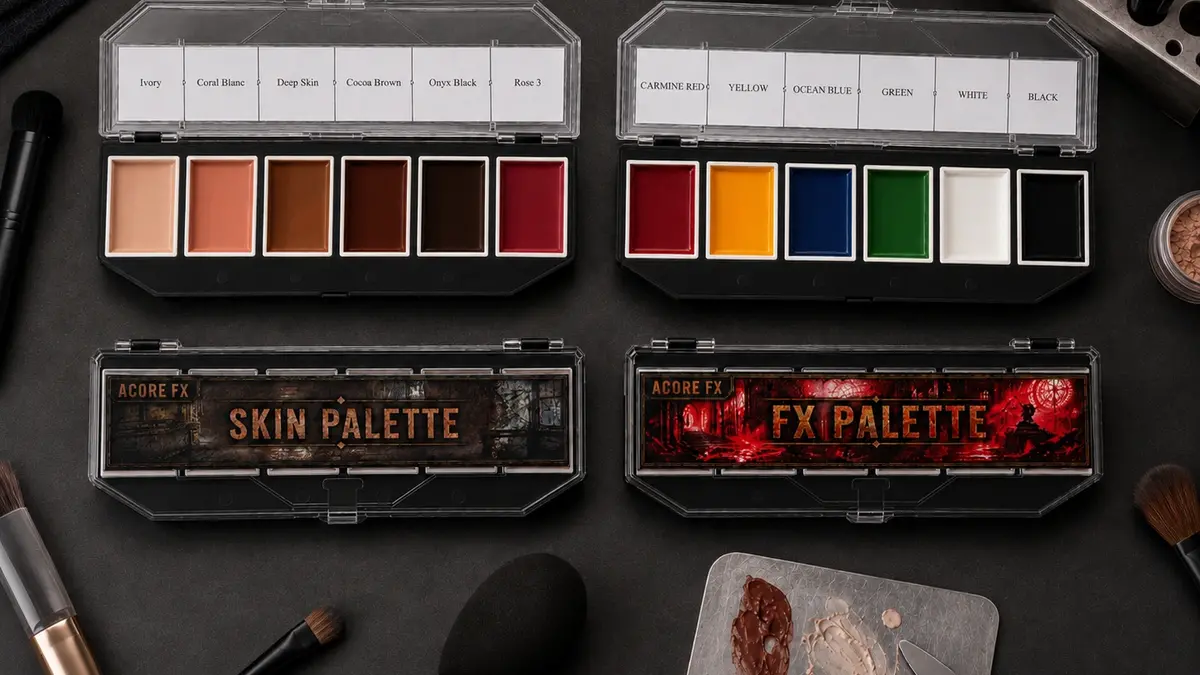
Alcohol-activated makeup palettes are the professional standard in film, theatre and SFX: unlike water-based makeup, they don't run with sweat or stage rain, they are activated and blended with the same isopropyl alcohol, and they can be applied both on skin and on silicone or latex prosthetics without any issue. The new Acore FX Skin Palette and Acore FX FX Palette are the duo designed for exactly that: one to match the real skin tone with any prosthetic, the other to create the effect on top (wounds, bruises, ageing). Both include their own 99% isopropyl alcohol activator in a 30 ml bottle, so you don't need to buy anything extra to get started. In this guide we walk you through how to use them step by step.
Why alcohol-activated makeup is used in SFX
Alcohol-activated makeup is dry pigment pressed into the palette itself, which is activated by rubbing a brush or sponge moistened with isopropyl alcohol directly onto the colour. The alcohol momentarily dissolves the pigment so it can be applied, then evaporates within seconds, leaving the colour set on the skin or prosthetic with no need for an additional sealer in most cases.
Compared to water-based makeup or creams, this offers three clear advantages for special effects: it resists sweat and water once dry, it can be applied in thin, translucent layers without obscuring the texture of a silicone prosthetic, and it allows colours to be blended directly on the skin with the brush rather than pre-mixing on a separate palette.
Skin Palette and FX Palette: what each one includes
| Palette | Colours | What it's used for |
|---|---|---|
| Acore FX Skin Palette | Ivory, Coral Balance, Deep Skin, Cocoa Brown, Onyx Black, Rose 3 | Blending the edge of a prosthetic with the real skin tone |
| Acore FX FX Palette | Carmine Red, Yellow, Ocean Blue, Green, White, Black | Creating effects on top: wounds, bruises, ageing, creatures |
Both include the activator: both the Skin Palette and the FX Palette come with their own bottle of 99% isopropyl alcohol (30 ml). You don't need to buy it separately to get started; you'll only need to replenish it when it runs out if you use them very intensively.
Materials you need
| Product | What it's used for |
|---|---|
| Acore FX Skin Palette | Skin tone base, 30 ml activator included |
| Acore FX FX Palette | Effect colours, 30 ml activator included |
Add to your list: a couple of brushes in different sizes (one wide for base work, one fine for detail), a makeup sponge or stipple sponge for texturing, cotton pads or wipes for touch-ups, and a separate brush or sponge reserved solely for the activation alcohol, free from any other product residue.
Step 1 — Prepare the skin or prosthetic
- Clean the area thoroughly with water and mild soap, and dry it completely. Do not apply moisturiser or oil just beforehand: grease causes alcohol-activated colour to adhere poorly and run.
- If you're working on an already-applied prosthetic, make sure the adhesive is completely dry and the edge is well blended against the skin before you start making up.
Step 2 — Activate the colour with the included alcohol
- Moisten the brush in the isopropyl alcohol activator included with the palette, without over-saturating it: it should be damp, not dripping.
- Gently rub the chosen colour in small circles until the brush picks up enough pigment. The colour looks more intense when wet and settles slightly as it dries, so there's no need to overload it.
- Work quickly but without rushing: the alcohol evaporates within seconds, giving you plenty of time to apply before it sets, but not enough to leave it loaded on the brush for long.
Step 3 — Blend the prosthetic with the Skin Palette
- Choose the base tone closest to the real skin from Ivory, Coral Balance, Deep Skin, Cocoa Brown, Onyx Black or Rose 3, and apply it with the wide brush over the entire surface of the prosthetic.
- Mix two tones on the skin if no single colour in the palette is an exact match: for example, Ivory + Coral Balance for warm light tones, or Deep Skin + Cocoa Brown for darker tones. Mixing on the spot is more reliable than searching for one perfect colour in the palette.
- Work the edge of the prosthetic with a stipple sponge, dabbing gently rather than making continuous strokes, so the transition between real skin and prosthetic doesn't show as a line.
Step 4 — Add the effect with the FX Palette
- Over the already-blended base, add the colours from the FX Palette (Carmine Red, Yellow, Ocean Blue, Green, White, Black) in thin, translucent layers, letting the skin tone show through underneath rather than covering it completely.
- Combine the 6 primary colours to achieve intermediate tones: Carmine Red + Ocean Blue gives bruises and veins; Yellow + Green gives sickly or decomposed tones; Black in small amounts darkens and adds depth without killing the colour beneath.
- Use the fine brush for details (veins, broken capillaries, wound edges) and the sponge to blend large areas of colour without leaving hard edges.
Practical example: how to mix a realistic bruise
A real bruise changes colour as the days pass, and you can reproduce those stages with the 6 colours of the FX Palette:
- Centre (fresh impact): Carmine Red with a touch of Ocean Blue, for an intense reddish-purple.
- Middle zone: Ocean Blue with a little Black, blended outwards with the sponge.
- Outer edge (healing phase): Green and Yellow mixed together, very diluted and blended until they fade into the skin tone.
- Final touch: a little White blended at the outermost edges to soften the transition and take any harshness off the overall look.
Step 5 — Seal the work
- Let the makeup dry for a few minutes before touching it or dressing the model, so the colour finishes setting.
- For long scenes or high-contact situations (filming, multi-hour conventions), a clear fixing spray on top helps the work hold up better against friction, although this isn't always necessary with alcohol-activated makeup once it's dry.
Professional tips
Keep one brush exclusively for the activation alcohol
If you use the same brush to activate the colour and for other tasks, you'll drag grease or residue from other products that can clump the palette pigment and ruin the colour over time.
Test the colour combination on the back of your hand before applying
Mixing directly on the prosthetic or model is risky if the tone doesn't turn out as expected. Test the colour on a discreet area of skin first.
Several thin layers is better than one thick layer
Alcohol-activated makeup looks more natural when applied in multiple translucent passes rather than a single heavy layer, because it lets the texture and colour of the skin or prosthetic show through underneath.
Clean the palette after each use
Run a dry tissue over the surface of each colour when you're done, to remove brush residue that could mix tones together on the next use.
Materials at Feroca
The full range of SFX makeup palettes is available at Feroca. If you're going to build a prosthetic from scratch before making it up, check out our EasyGel FX silicones guide, and if it's your first time with special effects, the SFX starter kit will help you put together the basic kit.
Frequently asked questions
Do the Acore FX palettes include the alcohol activator?
Yes. Both the Skin Palette and the FX Palette include their own 30 ml bottle of 99% isopropyl alcohol. You don't need to buy anything separately to get started.
What's the difference between the Skin Palette and the FX Palette?
The Skin Palette contains 6 skin tones (Ivory, Coral Balance, Deep Skin, Cocoa Brown, Onyx Black, Rose 3) for blending prosthetics with real skin. The FX Palette contains 6 primary colours (Carmine Red, Yellow, Ocean Blue, Green, White, Black) for creating effects on top: wounds, bruises, ageing or creature tones.
Can I use alcohol-activated makeup directly on skin, without a prosthetic?
Yes, both palettes work just as well applied directly on clean, dry skin as on a silicone or latex prosthetic.
How is alcohol-activated makeup activated?
By moistening a brush or sponge in the isopropyl alcohol included with the palette and gently rubbing it over the chosen colour until you pick up enough pigment. The alcohol evaporates within seconds and leaves the colour set.
How do I make a realistic bruise with the FX Palette?
Combine Carmine Red with a touch of Ocean Blue at the centre, Ocean Blue with Black in the middle zone, and Green with Yellow very well blended at the outer edge, finishing with a little White to soften the transition to the skin.
Does alcohol-activated makeup hold up against sweat or water?
Yes, once dry it resists sweat and contact with water well, unlike traditional water-based makeup, making it more reliable for shoots, stage performances or long conventions.
Comments (0)