Shopping Cart


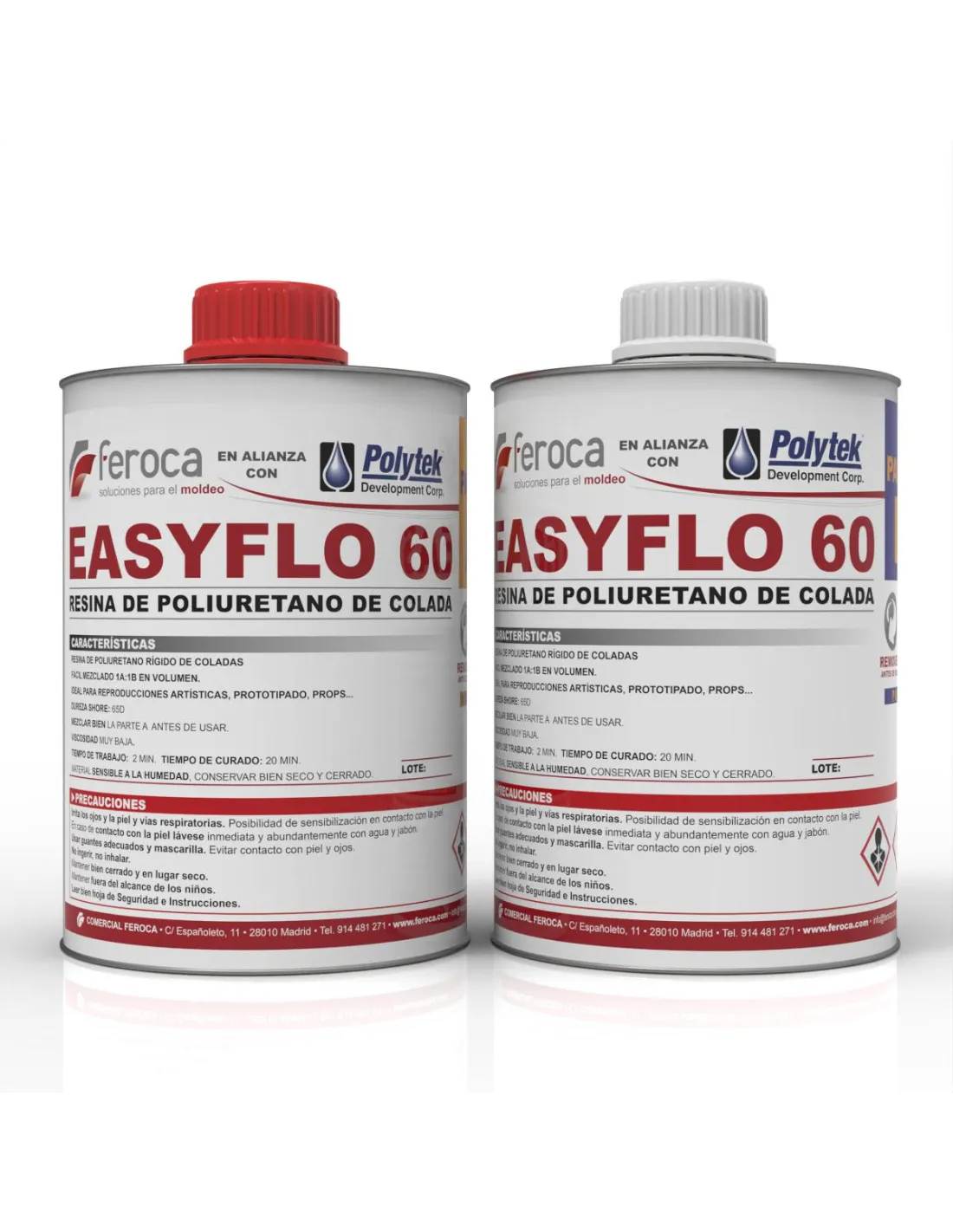
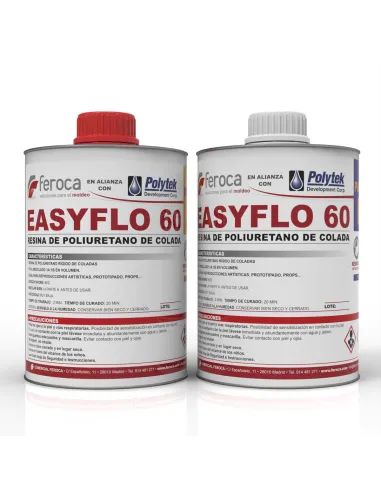
EasyFlo 60 -White Polyurethane Resin-
431005101
€20.00
24,20 € Tax incl.
24,20 € Tax incl.
Bright white polyurethane resin, 1:1 mix by volume, 2.5 min pot life, 65D hardness. Ideal for reproductions, prototypes and FX.
EasyFlo 60 is an ultra-low viscosity polyurethane resin (60 cP) that produces bright white casting parts, virtually bubble-free without the need for a vacuum chamber. With a simple 1:1 mix by volume and a pot life of just 2.5 minutes, it is the most straightforward option for part reproduction, rapid prototyping and special effects props.
Technical specifications
| Parameter | Value |
|---|---|
| Application | Casting |
| Colour | Bright white |
| Mix ratio by volume | 100A : 100B |
| Mix ratio by weight | 100A : 90B |
| Mixed viscosity | 60 cP |
| Pot life | 2.5 min |
| Cure time | 15-30 min* |
| Shore Hardness | 65D |
| Exothermic peak | 110 ºC |
| Shrinkage | 0.0041% |
* Cure time varies depending on cast mass and ambient temperature.
What it is used for
Thanks to its exceptional fluidity and fast cure cycle, EasyFlo 60 fits any process where faithful detail reproduction, high productivity and parts ready to finish or machine in a short time are required:
- Reproduction of small and medium-sized sculptures and artistic pieces
- Rapid prototyping of industrial or design parts
- Props and set dressing for special effects (film, television, theatre)
- Parts for rotational moulds
- Series production of decorative or signage elements
- Architectural or engineering scale models
- Reproduction of parts that will subsequently be painted or lacquered
How to use it
- Prepare the mould: make sure the mould is clean and dry. Apply a release agent if the mould is not silicone or if the surface is porous, to ensure clean demoulding without damaging the part.
- Bring components to temperature: keep part A and part B at room temperature (20-25 ºC). In cold environments, curing slows down and more bubbles may appear.
- Weigh or measure the components: mix in a ratio of 100A:100B by volume or 100A:90B by weight. For greater accuracy, use a precision scale.
- Mix carefully: stir for approximately 30-40 seconds, scraping the sides and bottom of the container. Avoid whipping to prevent introducing unnecessary air.
- Cast immediately: you have 2.5 minutes of pot life. Pour the mixture in a thin stream from a certain height to break any bubbles as it falls.
- Allow to cure: the material reaches demoulding rigidity in 15-30 minutes depending on mass and temperature. Do not force demoulding prematurely.
- Demould and finish: the part can already be sanded, painted, lacquered or machined. To colour in bulk, add PolyColor pigments to part A before mixing with part B.
Warning — High exothermic peak: EasyFlo 60 reaches an exothermic peak of up to 110 ºC in large-volume castings. Avoid massive castings in closed moulds or moulds made from heat-sensitive materials. With platinum silicone moulds, make sure the resin has reached room temperature before pouring to avoid degrading the mould. Do not use polystyrene foam moulds without a protective barrier, as the heat and solvents from the polyurethane may damage them.
Tips for use
Bubble control without a vacuum chamber
EasyFlo 60's viscosity of 60 cP is so low that bubbles rise and burst on their own in most cases. To maximise this effect, pour the mixture in a thin, continuous stream from around 20-30 cm in height. If the mould has complex geometries, tilt it slightly during the first few minutes so that air can escape. Only in the case of highly technical parts with deep undercuts is it worth using a vacuum chamber.
Pigmentation and finishes
EasyFlo 60 works perfectly with PolyColor pigments. Add the pigment to part A, mix thoroughly until the colour is uniform, then incorporate part B. Do not exceed 3-5% pigment by total weight to avoid altering the mechanical properties. Cured parts can be painted with water-based or solvent-based paints and can be machined with a milling machine, lathe or sander without any problem.
Storage and shelf life
Keep containers tightly closed and away from moisture. Part B is particularly sensitive to ambient humidity: if the container has been open for some time, check that it has not thickened or formed lumps before use. Store between 18 and 25 ºC. Once opened, use within a reasonable period to ensure correct reactivity of the components.
Frequently asked questions
Do I need a vacuum chamber to work with this resin?
In most applications, no. EasyFlo 60 has a viscosity of just 60 cP, which allows bubbles to escape on their own during casting. Pouring in a thin stream from a certain height is sufficient to obtain virtually bubble-free parts. Only with very complex geometries or highly technical parts might the use of vacuum be advisable.
What type of mould is compatible with this resin?
EasyFlo 60 works well with silicone moulds (both condensation and platinum), flexible polyurethane moulds and rigid resin or plaster moulds treated with a release agent. Avoid direct contact with polystyrene foam without a protective barrier. With porous moulds such as plaster or wood, always apply a release agent or several coats of sealer before casting.
Can I colour the resin directly in the mix?
Yes. EasyFlo 60 works very well with PolyColor pigments. Add the pigment to part A before mixing with part B, ensuring a homogeneous dispersion of colour. Keep the pigment proportion below 5% by weight to avoid compromising the final mechanical properties.
How long do I have to work once both parts are mixed?
The pot life of EasyFlo 60 is approximately 2.5 minutes at room temperature (20-25 ºC). This is a short time, so it is advisable to have the mould prepared and ready before starting to mix. In warmer environments the time is even shorter; in cooler environments it is slightly longer.
Can the parts be sanded, painted or machined?
Yes. Once cured, EasyFlo 60 parts are rigid (65D Shore) and can be sanded, milled, drilled, turned and painted without difficulty. They accept water-based and solvent-based paints, as well as conventional lacquers and primers.
Is it necessary to use a release agent?
It depends on the mould. With silicone moulds, it is generally not necessary for the first castings, although applying a release agent extends the life of the mould. With any other material (resin, plaster, wood, metal), the use of a release agent is essential to ensure clean demoulding without damaging the part or the mould.
What is the difference between EasyFlo 60 and other rigid polyurethane resins?
EasyFlo 60 stands out for its extremely low viscosity (60 cP) and very short pot life (2.5 min), making it ideal for rapid casting and series production. Other resins such as Feropur PR55+E55 offer a longer pot life and may be more suitable for large parts or processes where more working time is needed.
Is the resin resistant to moisture and solvents?
Yes. Cured EasyFlo 60 parts show good resistance to moisture and mild solvents. They are not suitable for prolonged immersion in strong solvents or for applications involving continuous contact with aggressive chemical agents.
Video tutorials
EASYFLO 60 · White Polyurethane Resin
4 · Tutorial: Casting with Polyurethane Resin
📲 Feroca TutoReel: Metallic finishes 📀
- Color
- White
- Working Time
- 2.5 min
- Curing Time
- 15-30min
- Shore Hardness
- 65D
- Volume Mixing Ratio
- 100A:100B
- Mixed Weight Ratio
- 100A:90B
- Application
- Casting
No reviews
Tap to zoom