Shopping Cart


Round EVA profile 1 meter
208260010
€4.00
4,84 € Tax incl.
4,84 € Tax incl.
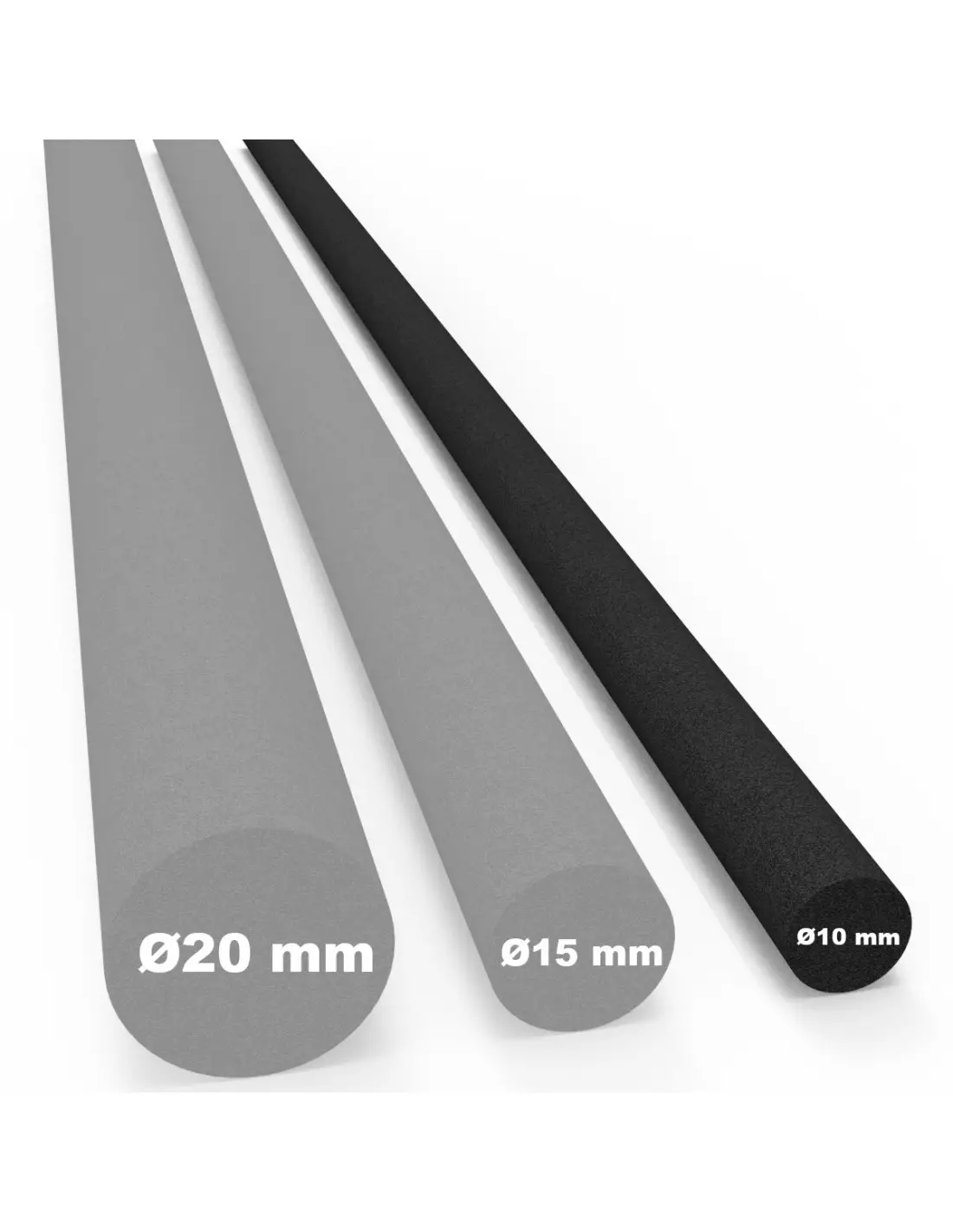
Prefabricated 1 m round EVA profile for edging, ribs and false pipes on cosplay and props. Diameters Ø10, Ø15 and Ø20 mm.
The Round EVA Profile is a prefabricated EVA foam moulding with a circular cross-section designed to add edging, ribs and raised details directly onto any foam base without the need to carve from scratch. Available in Ø10, Ø15 and Ø20 mm diameters in 1-metre lengths, it combines lightness, ease of cutting and thermoformability with gentle heat, making it an essential resource for cosplay, props and special effects.
Technical specifications
| Parameter | Value |
|---|---|
| Material | EVA foam (ethylene-vinyl acetate) |
| Cross-section | Circular (round) |
| Available diameters | Ø10 mm / Ø15 mm / Ø20 mm |
| Length | 1 metre per unit |
| Hardness | 30 – 35 Shore A |
| Thermoformable | Yes (heat gun at low temperature) |
| Recommended adhesive | Contact cement |
| Machinable | Yes (craft knife, scissors, fine sandpaper) |
What it is used for
The round profile covers any situation where you need a clean, consistent linear relief without wasting time carving. Its most common workshop applications are:
- Perimeter edging on cosplay armour: pauldrons, chest plates, shin guards.
- Decorative ribs and "strakes" on helmets and masks.
- False pipes and conduits on science fiction and fantasy props.
- Grips and guards on swords, spears and prop weapons.
- Joint trims to conceal seams between sheet foam pieces and provide visual continuity.
- Frames and dividers in mecha or sci-fi panel layouts.
- Volumetric details on theatre or audiovisual sets and scenery.
How to use it
- Measure and cut: Mark the required length on the profile with a marker and cut with a craft knife or scissors in a single clean movement to obtain a straight end.
- Thermoform if you need a curve: Apply gentle heat with a heat gun at around 60–80 °C until the profile softens. Bend it over the desired surface or template and hold pressure until it cools and retains the shape.
- Prepare the base surface: Clean the bonding area on your high-density foam piece, removing dust or paint residue. A clean surface ensures maximum adhesion.
- Apply contact cement: Spread a thin layer of contact cement on both the flat side of the profile and the base. Allow both surfaces to off-gas for the time indicated by the adhesive (usually 3–5 minutes).
- Bond and press: Join the two cement-coated surfaces precisely from one end to the other. Press firmly with your fingers or a small roller to ensure full contact.
- Adjust details: Once bonded, you can lightly sand the ends with fine sandpaper to finish joints or cut angles.
- Seal and paint: Apply a coat of flexible sealer or primer before painting to achieve a uniform and durable finish.
Tips for use
Temperature control when thermoforming
Keep the heat gun moving constantly at a minimum distance of 5–8 cm from the profile. EVA softens quickly: excessive localised heat can cause bubbles or deform the circular cross-section irregularly. If you need a tight curve, work in short sections of 10–15 cm and bend progressively.
Angled cuts for clean joints
For 90° corners or mitre joints, cut both ends at 45° with a craft knife. Slightly heat the ends before bonding so the EVA gives way and the fit is perfect with no visible gaps. A clean, straight cut is worth far more than lots of filler afterwards.
Combining with foam sheets
The round profile reaches its full potential when combined with 5 mm foam sheets as a structural base and with 2 mm foam for fine details. Plan the layer hierarchy before bonding: large pieces first, then the relief profiles, and finally the smaller details.
Frequently asked questions
Can you paint directly onto EVA foam?
EVA foam needs a flexible sealer or primer before painting, as its porous surface absorbs unevenly and rigid paints tend to crack with movement. Apply one or two coats of sealer, allow to dry and then paint with flexible acrylics or paints specifically designed for foam. The Round EVA Profile responds just like any other EVA piece once sealed.
Which adhesive works best for bonding these types of profiles?
Contact cement is the most common and effective option for bonding EVA profiles onto foam bases. Apply to both surfaces, allow to off-gas and join with pressure. For high-stress areas or very tight curves, you can reinforce the bond with a blast from a heat gun after joining to activate adhesion.
How do you achieve a tight curve without the profile deforming?
Heat the profile in short sections of around 10–15 cm with the heat gun at a low temperature, bend progressively over a template or mould and hold pressure until it cools completely. Working in small sections and gradually avoids ovalling or collapse of the circular cross-section.
Which diameter should I choose depending on the type of detail?
Ø10 mm is ideal for fine ribs, decorative lines and details on small pieces. Ø15 mm is the most versatile: it works well as edging on medium-sized armour and as a human-scale false pipe. Ø20 mm is designed for large pieces, main pipes on large-scale props and structural trims in scenery.
Can it be sanded to smooth the ends or adjust the profile?
Yes. EVA sands easily with fine sandpaper (220 grit or higher). It is useful for smoothing cut ends, refining joints and removing burrs. Sand with gentle movements and without excessive pressure to avoid deforming the cross-section.
How many profiles do I need to cover the perimeter of a standard pauldron?
It depends on the size of the piece, but an adult-sized cosplay pauldron typically has a perimeter of between 60 and 90 cm. One metre of Round EVA Profile is enough to cover a complete pauldron with some margin for tests and finishing. For larger pieces such as full chest plates, allow between 1.5 and 2 metres.
Is it suitable for outdoor use or high ambient temperatures?
EVA is reasonably stable at room temperature, but bear in mind that it is thermoformable: very high temperatures (inside a car in summer, a very close studio light, prolonged intense sun exposure) can soften the material and alter its shape. For prolonged outdoor use or high-temperature environments, consider applying a rigid sealer to provide additional dimensional stability.
Can it be cut diagonally to create conical or pointed details?
Yes. The Round EVA Profile can be cut at any angle with a craft knife. A pronounced bevel cut creates a pointed end that simulates a conical rivet or the start of a rib. The sharper the blade, the cleaner the cut and the less sanding needed afterwards.
No reviews
Tap to zoom