
Shopping Cart
- Feroca
- Cosplay
- 0 likes
- 1832 views
- 0 comments
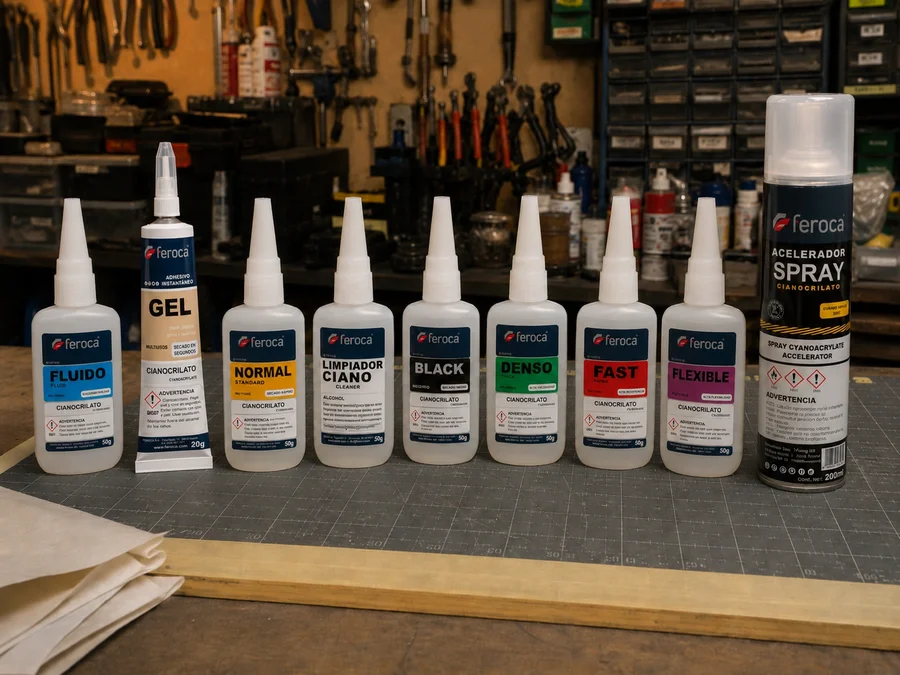
Cyanoacrylate adhesives —"cyanos"— are the fastest bonding tool in cosplay, SFX, model making and repairs. At Feroca we manufacture our own range of six different formulations, an accelerator spray and a specific solvent to cover any situation. In this article you'll find what sets each cyano apart, when to use each one and how to apply them correctly.
What cyanoacrylate is and how it works
Cyanoacrylate is a one-component adhesive that polymerises on contact with the moisture present in the air and on the surface of materials. No mixing or catalyst is needed: apply the adhesive to one of the surfaces, bring the pieces together and hold them under pressure. Under normal conditions (20 °C, 50% RH), tack occurs within seconds and maximum strength is reached in 24 hours.
The viscosity of the cyano is the key to choosing the right one. An ultra-thin cyano penetrates by capillary action into precision-fit joints; a thick cyano stays exactly where you place it and fills small gaps; a gel won't run on vertical surfaces. The other variants —black, flexible— add specific finishing properties and mechanical behaviour to the cured polymer.
The Feroca range: comparison of the 6 cyanos
| Product | Viscosity | Best for |
|---|---|---|
| Ciano Ultra Thin | Very low | Fine-fit joints, capillary penetration, metals and rigid plastics |
| Ciano Normal | Medium | General use: metal, plastic, wood, ceramic, leather, rubber |
| Ciano Thick | High | Gapped joints, uneven surfaces, prevents seepage |
| Ciano Gel | Thixotropic gel | EVA foam, porous materials, vertical surfaces, adjustment time |
| Ciano Black | Medium-high (245–325 cps) | Metal, rubber and dark plastic where the joint must not be visible |
| Ciano Flexible | Medium | Rubber, fabrics, leather, materials that bend or vibrate |
The 3 standard cyanos: Ultra Thin, Normal and Thick
The first decision when choosing a cyano is viscosity. Feroca's standard range offers three levels that cover virtually any common bonding situation.
Ciano Ultra Thin — for perfect fits
This is the lowest-density cyano in the range. Its extreme fluidity allows it to penetrate by capillary action into the micro-gap between two well-matched surfaces —3D-printed parts, machined metals, precision assemblies— spreading across the entire contact area before polymerising. The result is a very strong bond with a minimal amount of product.
- When to use it: parts that fit together with very little clearance, metals, hard plastics, electronics, scale models.
- When not to: surfaces with a visible gap, porous materials (absorbed before bonding), vertical surfaces (runs).
Ciano Normal — the most versatile
The Ciano Normal has a medium viscosity that makes it the go-to general-purpose option: it doesn't run as easily as the ultra-thin, but it's not as hard to spread as the thick. It bonds metals, plastics, ceramics, wood, leather and rubber. If you're not sure which one to pick and the surface is neither very smooth nor very porous, this is your cyano.
- When to use it: general repairs, cosplay workshop for rigid parts, bonding accessories, any standard application.
- Tip: combine it with the Accelerator Spray for an instant bond without having to hold the pieces together.
Ciano Thick — for gaps and difficult surfaces
The Ciano Thick is the highest-viscosity formulation in the standard range. Its high viscosity means the adhesive stays exactly where you place it, without seeping under the parts or running on angled surfaces. Curing is slightly slower than the other standard cyanos, giving you a little extra time to adjust the position.
- When to use it: joints where there's a small gap between parts, rough or semi-porous surfaces, filling small cracks before sanding, parts you can't tilt during bonding.
- When not to: precision fits where you need the cyano to flow (use the ultra thin), very porous materials like EVA (use the gel).
Ciano Gel: for EVA and vertical surfaces
The Ciano Gel 20g has a thixotropic gel viscosity: at rest it doesn't flow, but when pressure is applied through the nozzle it becomes workable. This makes it essential when working with EVA foam: standard cyanos are absorbed into the foam before they can bond, whereas the gel forms a surface film that creates a clean, strong joint.
The tack time of 19 to 180 seconds is longer than the rest of the range, giving you real working time to adjust the position of the parts before they set permanently.
- Ideal for: EVA foam in cosplay and SFX, vertical surfaces where a liquid cyano would run, porous or semi-porous materials, joints where you need adjustment time.
EVA tip: apply a small drop of Ciano Gel, wait 3–5 seconds for it to form a film and then press. If you want an instant bond, apply the Ciano Gel on one side and a spray of Accelerator Spray on the other: the bond is almost instantaneous.
Ciano Black: metal, plastic and dark rubber
The Ciano Black 50g is a black cyanoacrylate with medium-high viscosity (245–325 cps) formulated for metals, technical plastics and rubber. The black colour of the cured adhesive makes it indistinguishable on dark materials, where the white or transparent line left by standard cyanos would be visible in the final finish.
With a tack time of 5–20 seconds it is one of the fastest in the specialist range. It's the go-to adhesive for repairing shoe soles, bonding metal components on cosplay armour or joining black rubber parts where the aesthetics of the joint matter.
Ciano Flexible: for materials that bend
The Ciano Flexible 50g incorporates plasticisers into its formulation that, once cured, allow the joint to deform without fracturing. It's the solution when you need the speed of a cyano but the material will be subject to flexing, vibration or impact. Standard cyanos cure like glass; if the material bends, the joint cracks.
Added benefit: it has no penetrating odour and no mandatory hazard pictograms, making it more comfortable to use in spaces without industrial ventilation.
- Ideal for: rubber and silicone, leather and technical fabrics, shoe repair, articulated cosplay accessories, soft foams, any material that flexes in real use.
Accelerator Spray: instant bonding
The Ciano Accelerator Spray is the accessory that multiplies the speed of any cyano in the range. Apply a fine mist to one of the two surfaces before joining them, put the cyano on the other surface, bring together and press: the reaction with the accelerator initiates polymerisation instantly, with no need to hold pressure for seconds.
It's especially useful on large parts where maintaining even pressure is difficult, in vertical applications where the cyano might run before setting, or simply when you want to work faster.
- How to use it: spray the accelerator on one surface only and let it dry for 10–15 seconds. Apply the cyano to the other surface. Join and press for 2–3 seconds.
- Compatible with: all Feroca cyanos — Ultra Thin, Normal, Thick, Gel, Black and Flexible.
- Caution: using too much accelerator can whiten the joint. A fine mist from 15–20 cm away is enough.
Limpiaciano: how to remove cyanoacrylate residue
The Limpiaciano 20g is the specific solvent for cured cyanoacrylate. It breaks down the polymer, making it possible to separate incorrectly bonded joints, remove adhesive residue from tools and clean fingers without damaging the skin.
- To separate parts: apply a drop around the perimeter of the joint, wait 2–5 minutes and apply gentle lateral pressure. The solvent penetrates along the adhesive line and softens the polymer.
- For fingers: a few drops rubbed gently will dissolve the cyano from skin in 30–60 seconds.
- For the nozzle: clean the tip of the cyano container with a cloth dampened with Limpiaciano after each use to prevent blockages.
Tip: always keep the Limpiaciano next to whichever cyano you're using. Most problems —parts bonded in the wrong position, blocked nozzles, stuck fingers— are solved in seconds if you have the solvent to hand.
How to apply a cyanoacrylate correctly
- Prepare the surfaces: clean both faces with isopropyl alcohol to remove grease and dust. Clean, slightly roughened surfaces (220-grit sandpaper) give the best strength.
- Choose the right cyano: fine fit → Ultra Thin; general use → Normal; gap → Thick; EVA or vertical → Gel; dark → Black; flexible → Flexible.
- Use the minimum amount on one surface only: one small drop per 5–10 cm². Excess weakens the bond and causes white spots.
- Optional — accelerator: spray the Accelerator Spray on the opposite surface for an instant bond.
- Press and hold until the initial tack is achieved.
- Wait for full cure: 24 hours for maximum mechanical strength.
| Common mistake | Solution |
|---|---|
| Too much adhesive → weak joint and white spots | One small drop is enough |
| Greasy surface → doesn't bond or fails within hours | Clean with isopropyl alcohol first |
| Liquid cyano on EVA → absorbed, doesn't bond | Use Ciano Gel |
| Blocked nozzle → container unusable | Clean tip with Limpiaciano after each use |
| Rigid joint on flexible material → cracks | Use Ciano Flexible |
Frequently asked questions
Which cyano should I use to bond EVA foam?
For EVA foam use the Ciano Gel. Standard cyanos are absorbed into the foam before they can bond. Apply a small drop, wait 3–5 seconds for it to form a film and then press. For a faster bond, combine it with the Accelerator Spray: apply the gel on one side and the accelerator on the other.
When should I use the Accelerator Spray and when shouldn't I?
The Accelerator Spray is useful when you want virtually instant bonding, on large parts that are hard to hold, or on vertical surfaces. It's not needed for normal applications where you can hold pressure for a few seconds. Too much accelerator can cause white spots (blooming), so spray a thin coat from 15–20 cm away.
What's the difference between Ciano Ultra Thin and Normal?
The difference is the density of the adhesive. The Ultra Thin penetrates by capillary action into the space between parts that fit together well. The Normal has a medium viscosity and is more versatile for surfaces that don't fit perfectly or when you can't lay the part completely flat.
Why does a white spot appear around the joint?
"Blooming" or white haze occurs when cyanoacrylate vapour polymerises in the humid air around the joint. Common causes are excess adhesive, low temperature or too much accelerator. Solution: use the minimum amount, apply in a very thin layer and, if you use the accelerator, spray from a greater distance and with less product.
How long does an opened cyano bottle last?
Once opened, a well-capped cyano will last 4–8 weeks under normal conditions. The enemy is moisture entering through the nozzle. To extend shelf life: clean the tip with Limpiaciano after each use, cap tightly and store in a cool, dry place.
Can cyanoacrylate be used on very porous woods?
On very porous woods (balsa, cork, unsealed MDF) cyano is absorbed excessively. The Ciano Thick or Ciano Gel work best because their higher viscosity reduces absorption. You can also apply a first thin coat of Ciano Normal to seal the pores, let it dry, and then bond as normal.
Comments (0)