Shopping Cart


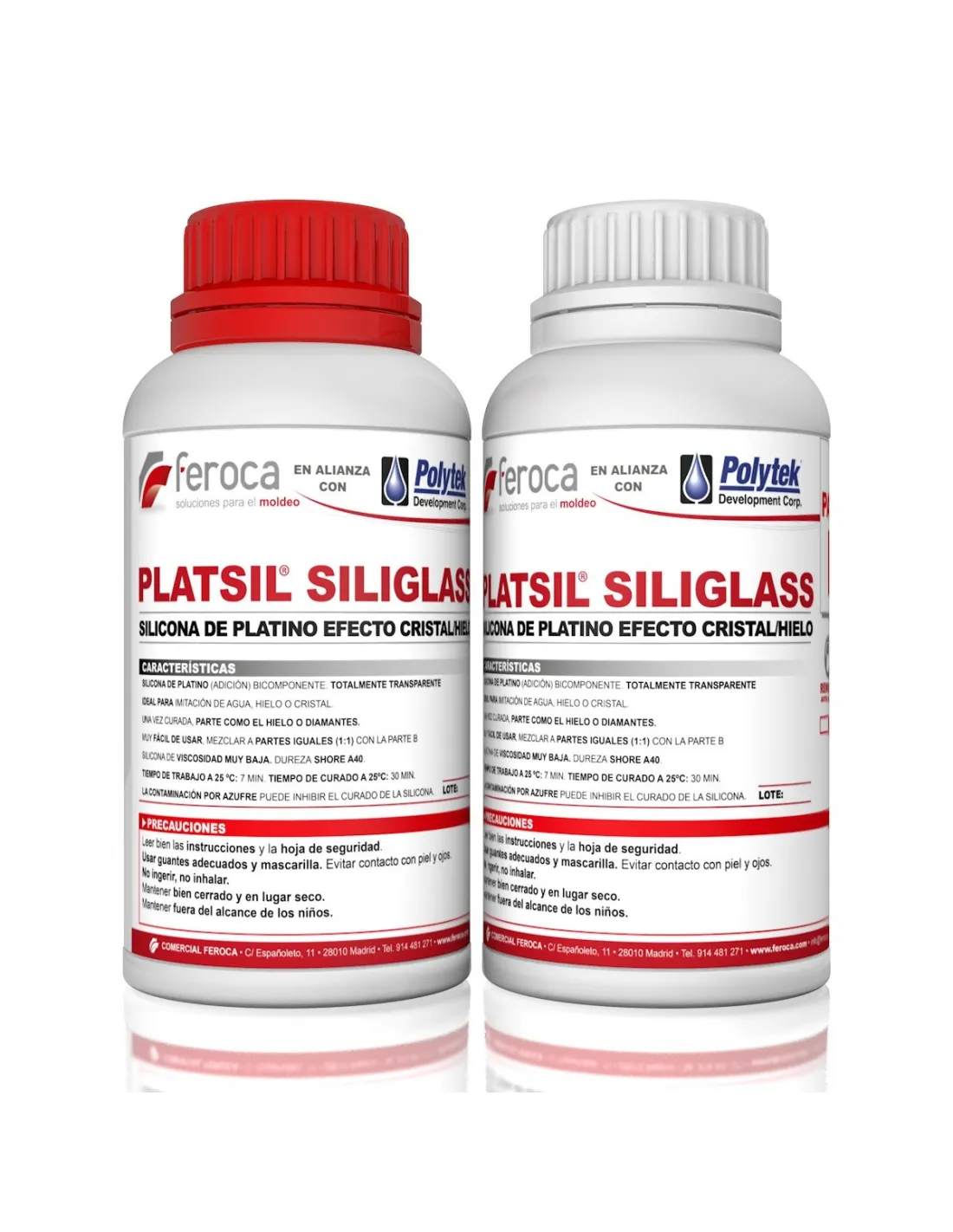
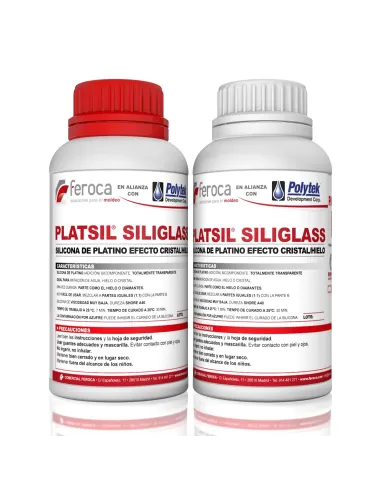
PlatSil SiliGlass -Water/Ice/Glass Effect Silicone-
290004801
€44.00
53,24 € Tax incl.
53,24 € Tax incl.
Transparent platinum silicone Shore A40, 1:1 mix ratio. Simulates water, encapsulates objects and, when broken, mimics ice, glass or diamonds.
PlatSil SiliGlass is a fully transparent platinum (addition) silicone formulated to encapsulate objects and create realistic water effects. It mixes in equal parts, cures at room temperature in 24 hours, and the result is a semi-rigid, crystal-clear and durable rubber. Once cured, if broken or crumbled, it perfectly mimics crushed ice, broken glass or diamonds, making it a versatile material for both special effects and decorative displays.
Technical specifications
| Parameter | Value |
|---|---|
| Color | Transparent |
| Shore Hardness | A40 |
| Mix ratio (weight) | 100A : 100B |
| Mix ratio (volume) | 100A : 100B |
| Pot life | 60 minutes |
| Cure time | 24 hours |
| System | Platinum silicone (addition) |
What it is used for
PlatSil SiliGlass is designed for all applications where a transparent, fluid and clean-curing material is needed. Its low viscosity and the absence of heat during curing make it particularly suitable for encapsulating delicate objects or working with thin-walled containers.
- Artificial water for floral displays: encapsulating flowers, stems and plant elements in decorative vases or fish tanks
- Still water or pond effects in scale models and dioramas
- Encapsulating objects for display or decoration (figures, insects, coins, etc.)
- Simulating ice cubes for product photography and food advertising
- Broken glass, diamond or shattered ice effects in film, television and special effects
- Filling decorative containers with artificial flowers or submerged elements
- Creating handmade jewellery or decorative pieces with embedded objects
How to use it
- Prepare the surface and the mould. Make sure the container or mould you are going to pour into is compatible with platinum silicone (no traces of latex, sulphur-based clay, uncured epoxy or tin silicone). If you are encapsulating an object, place and secure it if necessary to prevent it from floating when pouring.
- Weigh or measure parts A and B. Use a 1:1 ratio by both weight and volume. For best results, weigh using a precision scale.
- Mix carefully. Combine both parts in a clean container and mix slowly for 2–3 minutes, scraping the walls and bottom thoroughly. Avoid vigorous movements to minimise bubble incorporation.
- Pour. Tilt the container slightly and pour the mixture in a thin, continuous stream, allowing the material to flow on its own. This reduces bubble formation. If you have access to a vacuum chamber, degas the mixture before pouring for 1–2 minutes for absolute clarity.
- Remove surface bubbles if necessary. A very brief burst of heat from a heat gun at a distance (or simply waiting a few minutes) will cause surface bubbles to pop on their own thanks to the material's low viscosity.
- Allow to cure for 24 hours at room temperature. Do not handle the piece until curing is complete. At higher ambient temperatures (not exceeding 35 ºC), curing may speed up slightly.
- Demould carefully. Being a silicone, demoulding is straightforward and in most cases does not require a Release agent. If the container is permanent (vase, fish tank), simply leave the piece inside.
- Ice/broken glass effect (optional). Once cured, apply controlled pressure or impacts to fragment the block. The resulting pieces convincingly mimic ice, glass or diamonds.
Warning: inhibition in platinum silicones
PlatSil SiliGlass is an addition (platinum) silicone. Certain materials prevent it from curing on contact, leaving the silicone tacky or uncured. Avoid any contact with: latex, sulphur-containing clays or plasticines (sulphur-based), condensation (tin) silicones, uncured epoxy or polyester resins, urethane rubbers, vinyl and some unsealed metals. If you are unsure about the compatibility of a material, always perform a small test before working on the final piece. Clean all tools thoroughly before use.
PlatSil SiliGlass is an addition (platinum) silicone. Certain materials prevent it from curing on contact, leaving the silicone tacky or uncured. Avoid any contact with: latex, sulphur-containing clays or plasticines (sulphur-based), condensation (tin) silicones, uncured epoxy or polyester resins, urethane rubbers, vinyl and some unsealed metals. If you are unsure about the compatibility of a material, always perform a small test before working on the final piece. Clean all tools thoroughly before use.
Usage tips
Maximum clarity: control bubbles
The low viscosity of PlatSil SiliGlass already facilitates natural degassing, but if you need absolute clarity (product photography, advertising), degas the mixture in a vacuum chamber for 60–90 seconds before pouring. If you do not have a chamber, pour in a very thin stream from a height and leave the container undisturbed for at least 10 minutes before it starts to gel.
Colouring the water effect
You can add pigments specifically formulated for platinum silicones in very small amounts (1–3 drops per 100 g of mixture) to simulate lake water, murky water, coloured liquids or special effects. Incompatible pigments (uncertified oil-based, water-based dyes) may inhibit curing or remain floating. Always use pigments formulated for platinum silicone.
Controlled fragmentation for ice and broken glass effects
To obtain uniformly sized fragments, freeze the cured piece for 30 minutes before breaking it: the material becomes slightly more brittle and the edges come out cleaner and more angular. For very small "diamond"-type fragments, crush with a mallet inside a sturdy plastic bag. If the fragments will be exposed to the public or in contact with sensitive surfaces, smooth the sharpest edges with fine wet-and-dry sandpaper.
Frequently asked questions
Can I use any container as a mould?
Most rigid containers (glass, PP plastic, polyethylene, sealed wood) are compatible with PlatSil SiliGlass. Avoid containers made of vinyl, latex rubber or materials containing sulphur, as these would inhibit curing. If in doubt, apply a small amount to the bottom of the container and verify that it cures correctly before proceeding with the full piece.
What should I do if the silicone remains tacky after 24 hours?
A tacky or uncured surface almost always indicates inhibition from contact with an incompatible material (latex, sulphur, uncured epoxy, vinyl, etc.). Check all materials that have been in contact with PlatSil SiliGlass: the encapsulated object, the container, the mixing tools. If the inhibition is localised and superficial, in some cases it can be resolved by cleaning with isopropyl alcohol, but if it affects the entire mass, the piece cannot be salvaged and must be redone using properly clean and compatible materials.
Can the cure be accelerated or slowed down?
Heat accelerates the curing of platinum silicones: at 40–50 ºC in an oven, cure time can be reduced to 4–6 hours. Cold slows it down. It is not advisable to exceed 60 ºC during the curing process. To extend pot life, consult the use of specific retarders for platinum silicone, bearing in mind that excessive use may compromise the final cure.
Can it be pigmented to achieve coloured water effects?
Yes. PlatSil SiliGlass accepts pigments formulated for platinum silicones. Add the pigment to part A before mixing with part B, and blend thoroughly. Use very small amounts to maintain transparency or a translucent effect. Never use water-based dyes, printer inks or pigments not certified for platinum silicone, as they may inhibit curing.
How much working time do I have with the mixture?
PlatSil SiliGlass offers 60 minutes of pot life at room temperature (approximately 25 ºC). This is a generous working time that allows you to work at a comfortable pace, pour in multiple layers if needed, and remove bubbles. Remember that at higher temperatures pot life is shortened.
Is it suitable for food contact or skin contact?
PlatSil SiliGlass is not certified for Food Safe use or prolonged skin contact. If you need a platinum silicone with FDA certification or for dermal applications, please consult other products in the range specifically designed for these applications.
Can it be poured in layers for tall objects?
Yes, it can be poured in successive layers. Wait until the first layer has gelled (but not fully cured, approximately 4–6 hours) before pouring the next one, so that the layers bond together without visible lines. If the lower layers are fully cured, inter-layer adhesion is still good thanks to the nature of platinum silicone, although a subtle line may appear if the lower surface is very smooth.
Are the broken fragments of the material safe to handle?
Cured fragments of PlatSil SiliGlass are harmless and non-toxic. However, breaking the block generates sharp edges. Handle them with gloves and, if they are to be touched by the public or used in accessible decorations, smooth the sharpest edges with fine wet-and-dry sandpaper.
- Color
- Transparent
- Working Time
- 60min
- Curing Time
- 24horas
- Shore Hardness
- A40
- Volume Mixing Ratio
- 100A:100B
- Mixed Weight Ratio
- 100A:100B
No reviews
Tap to zoom