Shopping Cart


SikaBiresin F38 -Modeling resin-
422403001
€30.00
36,30 € Tax incl.
36,30 € Tax incl.
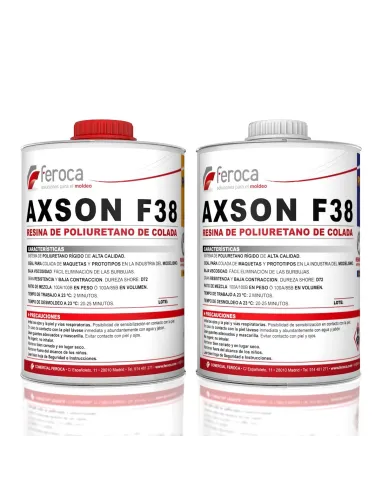
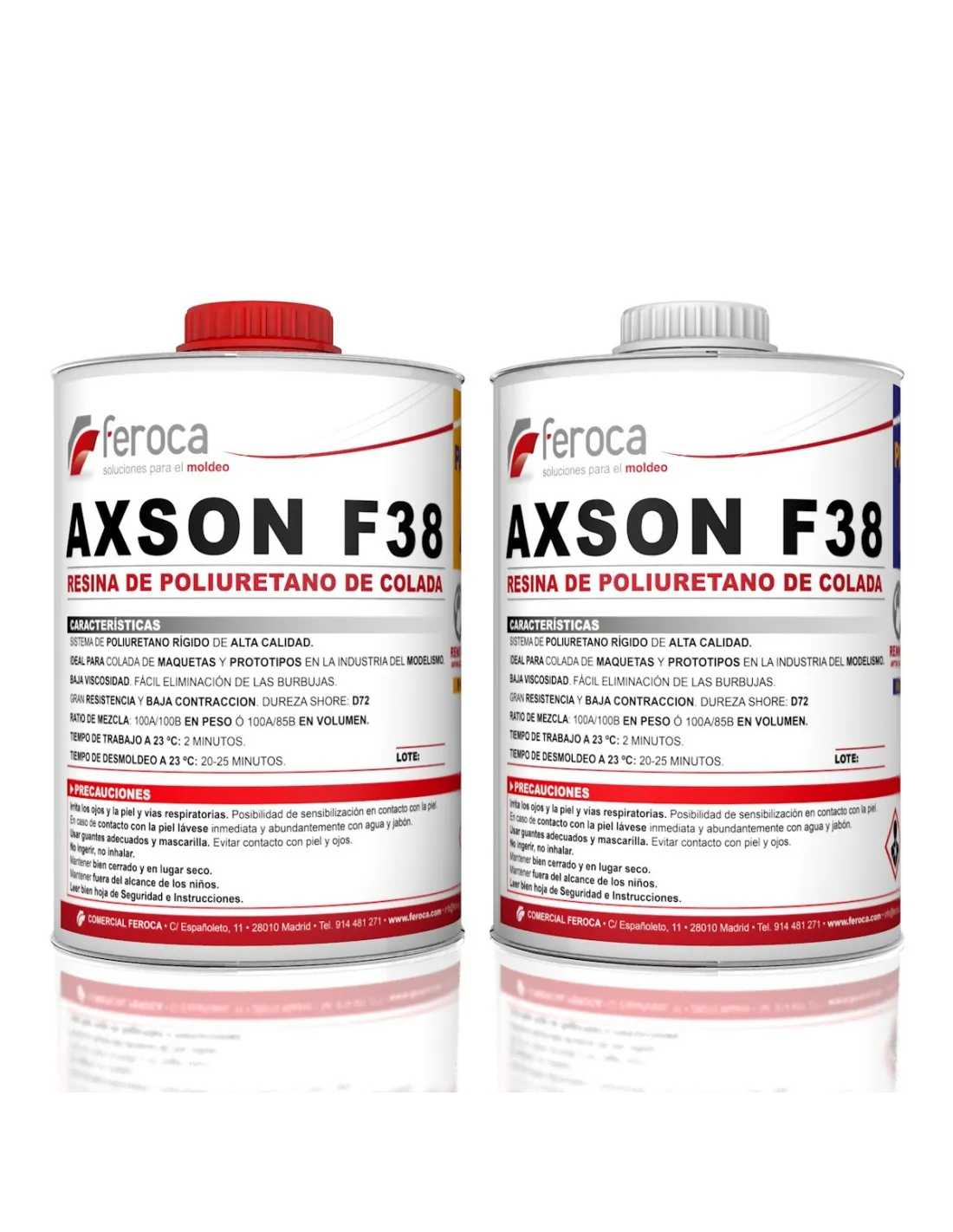
Rigid polyurethane resin for scale modelling. Shore Hardness 72D, pot life 2 min, demould in 20-25 min. Mix ratio 100A:100B by weight.
SikaBiresin F38 is a low-viscosity rigid polyurethane resin developed specifically for the scale modelling and prototyping industry. Its fast cure, minimal shrinkage and ability to reproduce fine details make it a well-established reference for mould casting throughout Europe.
Technical specifications
| Parameter | Value |
|---|---|
| Material type | Rigid polyurethane resin (2 components) |
| Application | Casting |
| Cured colour | Off-white |
| Shore Hardness | 72D |
| Mix ratio by weight | 100A : 100B |
| Mix ratio by volume | 100A : 85B |
| Pot life | ~2 minutes |
| Demould time | 20-25 minutes |
| Cured appearance | Rigid thermoplastic |
| Minimum processing temperature | 18 °C |
What it is used for
SikaBiresin F38 is designed for mould casting where dimensional accuracy, surface hardness and a fast production cycle are required. Its low viscosity allows the material to flow and fill every mould detail without mechanical assistance, and its 1:1 mix ratio by weight simplifies batch work.
- Manufacture of miniatures and collectible figures
- Industrial prototypes and scale models
- Static and scale modelling parts
- High-detail master reproduction
- Block casting for large moulds or batch production
- Parts for special effects and character work
- Decorative replicas and set dressing elements
How to use it
- Prepare your materials and workspace. Work at an ambient temperature of 18 °C or above. Both the mould and the components must be completely dry: any trace of moisture can cause bubbles or prevent proper curing.
- Homogenise part A (polyol). Before measuring, stir component A thoroughly until the colour and appearance are uniform. This step is essential to ensure the final cured properties.
- Apply release agent. If the mould is not self-releasing silicone, apply a suitable release agent for polyurethane to all mould surfaces and allow the solvent to evaporate.
- Weigh the components. Use a precision scale and mix at a ratio of 100A : 100B by weight. Avoid measuring by volume whenever possible, as the density of both parts differs (volumetric ratio 100A : 85B).
- Mix. Add part B to part A and stir vigorously for 20-30 seconds, scraping the sides and bottom of the container. You have approximately 2 minutes of pot life: be quick and precise.
- Cast into the mould. Pour the mixture in a continuous, thin stream to minimise air entrapment. If the mould has complex areas, tilt it to aid filling.
- Demould. After 20-25 minutes the part will be ready to demould. Full cure is completed in the following hours, at which point the part reaches its final hardness and mechanical strength.
- Post-processing. The cured part can be sanded, painted or primed with standard polyurethane finishing products.
Important notice — Polyurethane resin
Polyurethanes are sensitive to moisture during mixing and curing. Moisture in the mould, in the components or in the environment can cause bubbles, craters or cure failures. Always work with perfectly dry moulds and store components with their containers tightly closed to prevent absorption of atmospheric moisture. Always handle with gloves and in a well-ventilated space: the isocyanate (part B) is irritating to the respiratory tract and skin.
Polyurethanes are sensitive to moisture during mixing and curing. Moisture in the mould, in the components or in the environment can cause bubbles, craters or cure failures. Always work with perfectly dry moulds and store components with their containers tightly closed to prevent absorption of atmospheric moisture. Always handle with gloves and in a well-ventilated space: the isocyanate (part B) is irritating to the respiratory tract and skin.
Usage tips
Always weigh — do not measure by volume
The 100A:100B ratio by weight is straightforward and eliminates errors, but the volumetric ratio (100A:85B) is less intuitive and more prone to deviations. Use a precision scale from the very first use: a 5% ratio error can result in soft, tacky or incompletely cured parts.
Control the temperature of the material and the mould
Below 18 °C the pot life appears to extend, but curing becomes uneven and the final mechanical properties are compromised. If you work in a cold workshop, warm the components in a warm water bath (no more than 30 °C) before mixing. Likewise, a pre-warmed mould reduces initial viscosity and improves fine-detail filling.
Batch production and block casting
SikaBiresin F38 is particularly efficient for large batches thanks to its low viscosity and fast cycle time. If producing in series, prepare all moulds before starting to mix. For large-volume block castings, bear in mind that the reaction is exothermic: masses above 500 g can generate enough heat to deform foam moulds or heat-sensitive materials. In those cases, split the pour into layers or use silicone or metal moulds.
Frequently asked questions
What type of mould is most suitable for casting this resin?
Condensation or platinum silicone moulds are the most common due to their flexibility and ease of demoulding. SikaBiresin F38 can also be cast in properly released plaster, resin or metal moulds. Avoid moulds made from untreated porous materials or that contain moisture.
Do I need a release agent if I use a silicone mould?
In most cases silicone moulds do not require a release agent for polyurethane, as silicone naturally acts as a non-stick surface. However, with heavily aged moulds or those with high-retention geometries, a thin coat of spray release agent extends mould life and makes demoulding easier.
Why are there bubbles in my cast part?
The most common causes are: moisture in the mould or components, overly vigorous mixing that entraps air, or pouring too abruptly. To reduce bubbles, mix with smooth, steady movements, pour in a thin stream and, if you have a vacuum chamber, degas the mixture for 30-60 seconds before casting. SikaBiresin F38's low viscosity helps bubbles escape naturally in shallow parts.
Can this resin be pigmented?
Yes. You can add paste or powder pigments compatible with polyurethane. Add them preferably to part A (polyol) before mixing with part B to achieve a uniform colour. Bear in mind that the base cured colour is off-white, which makes it easy to achieve light and mid-range tones.
How much working time do I actually have once mixed?
The pot life is approximately 2 minutes from the start of mixing. After that point viscosity increases rapidly and the material stops flowing properly. It is essential to have the mould prepared and ready before starting to mix. For complex parts or block castings, work in small batches if necessary.
Can I use this resin for parts that will be subjected to impacts or mechanical stress?
SikaBiresin F38 achieves a Shore Hardness of 72D, comparable to a rigid thermoplastic, and offers good mechanical resistance for modelling parts, scale models and prototypes. However, for applications requiring high impact resistance or flexibility, polyurethane resins with more elastic formulations are available. Consult the technical data sheets of each product to compare specific mechanical properties.
How should I store unused components?
Close containers immediately after each use and store them in a dry place at temperatures between 15 °C and 25 °C, away from heat sources and moisture. Part B (isocyanate) is particularly sensitive to ambient moisture: if the container has been left open for a long time, check that no lumps or crystallisation have formed before use. Once opened, it is recommended to use them within a reasonable timeframe.
Can the finished parts be sanded, drilled or painted?
Yes. Once fully cured, SikaBiresin F38 behaves like a rigid thermoplastic and accepts conventional machining: sanding, drilling, milling and cutting. For painting, it is recommended to apply a primer specifically designed for rigid plastics before the topcoat, which improves adhesion and the durability of the final finish.
- Color
- Broken White
- Working Time
- 2min
- Curing Time
- 20-25min
- Shore Hardness
- 72D
- Volume Mixing Ratio
- 100A:85B
- Mixed Weight Ratio
- 100A:100B
- Application
- Casting
No reviews
Tap to zoom