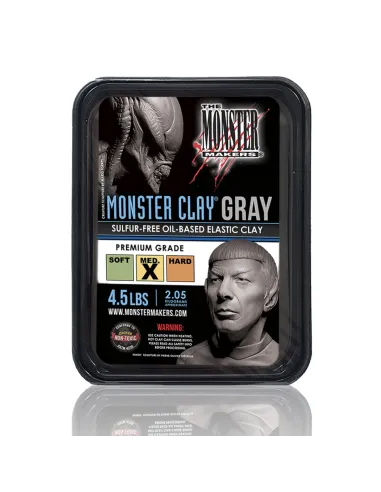
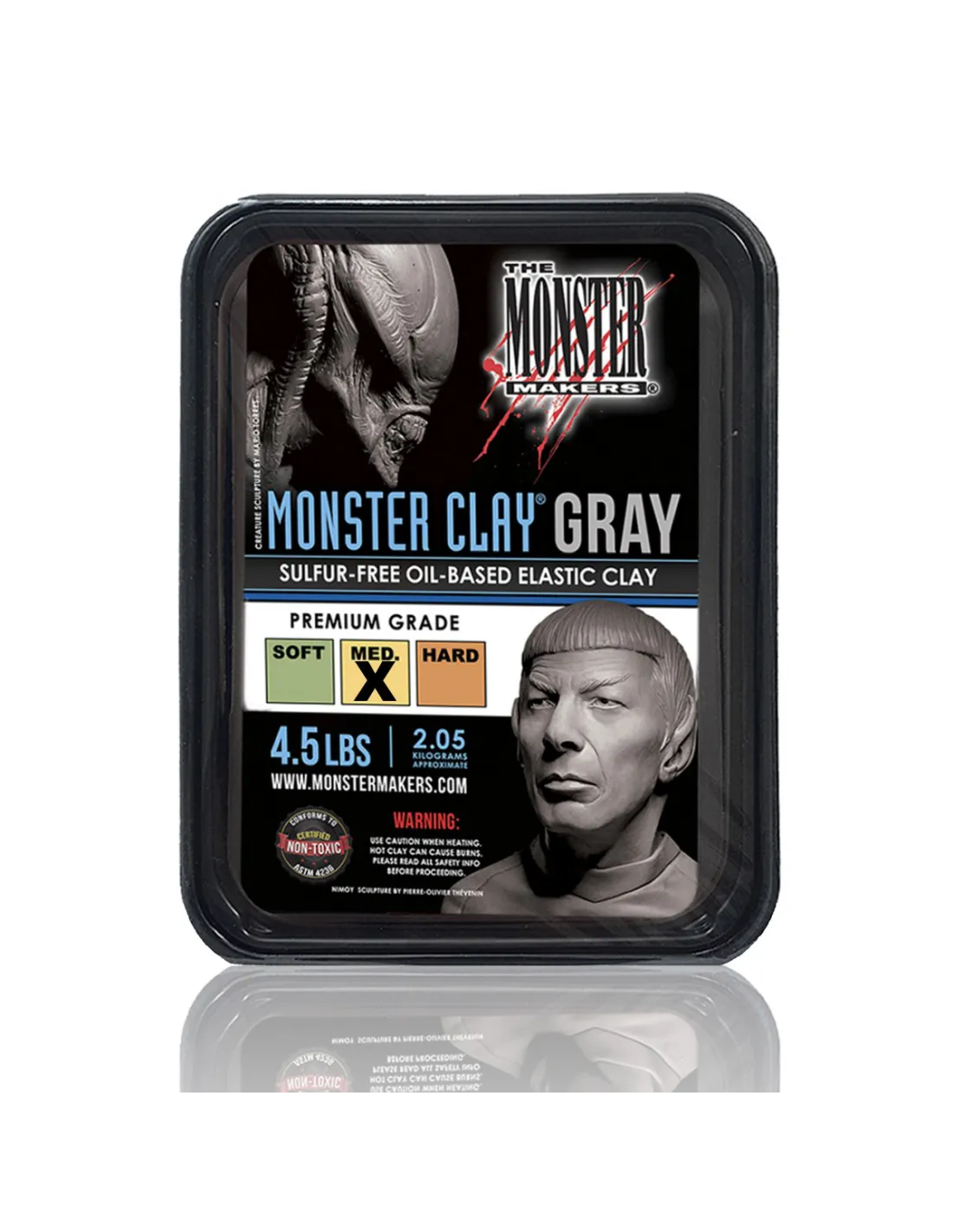
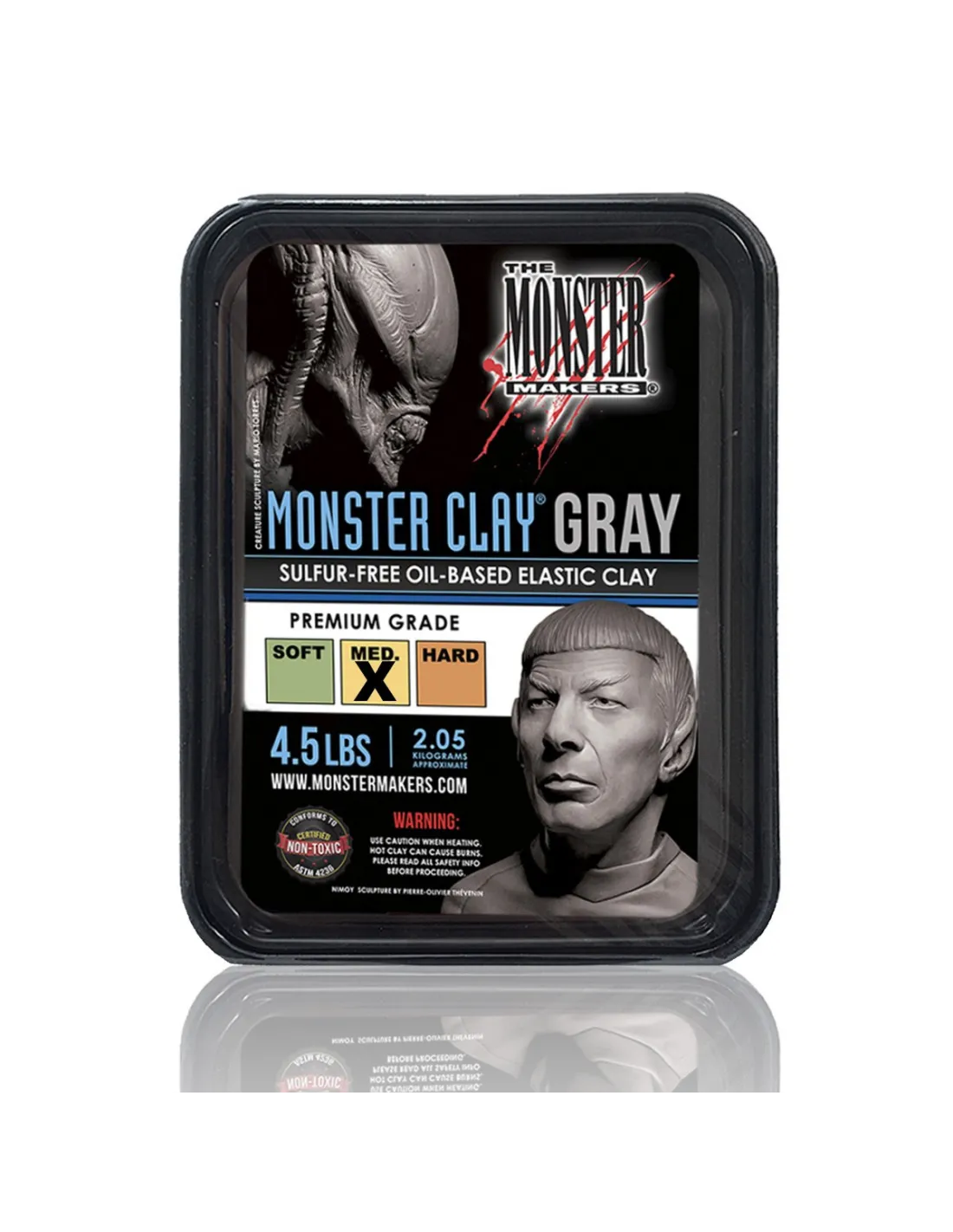
Monster Clay Gray Medium is a professional oil-based modelling clay, sulfur-free and indefinitely reusable. Its neutral grey colour reduces glare under studio lighting and allows precise reading of shape and volume while sculpting. Formulated with non-toxic, Food Safe components, it is the reference material in special effects, animatronics and prototyping when high detail resolution and direct compatibility with platinum silicones are required.
Technical specifications
| Property |
Detail |
| Colour | Grey |
| Hardness | Medium |
| Base | Oil-based |
| Sulfur content | Sulfur-free |
| Toxicity | Non-toxic — Food Safe components |
| Reusable | Yes, indefinitely |
| Weight per container | 2.05 kg (4.5 lb) |
| Microwave-safe container | Yes |
| Maximum oven temperature | 250 °C |
| Platinum silicone compatibility | Yes — sulfur-free formula |
What it is used for
Monster Clay Gray Medium is designed for professional and semi-professional sculpture where a high detail resolution material is needed that can be melted, poured or reshaped without limit. It is the standard material in special effects studios, animatronics workshops, character design and industrial prototyping.
- Character, creature and bust sculpting for film, television and special effects
- Master models for Mold-Making with platinum silicone or polyurethane
- Correction and retouching of Life Cast moulds before pulling copies
- Fine-detail prototyping in industrial design and product design
- Sculpting heads, busts and large-format pieces thanks to its excellent weight-to-plasticity ratio
- Fabrication of elements for animatronics and puppetry
- Creating textures and positives for stamping with texture stamps
How to use it
- Condition the material: If the clay is cold and hard, warm it briefly in the microwave using the original container (microwave-safe) in short 10–15 second intervals until it reaches a workable consistency. You can also use a heat gun or an oven at low temperature.
- Build the base structure: For large-volume pieces, start with a wire or rigid foam Armature to save material and reduce weight. Apply the clay in progressive layers.
- Sculpt the detail: Work with modelling tools, double-ended sculpting tools and modelling sticks to define shapes and textures. The material at room temperature offers greater resistance, which facilitates precise carving.
- Smooth surfaces: Use isopropyl alcohol applied with a brush to smooth the surface without distorting the volume. You can also lightly melt the outer layer with controlled heat.
- Add textures: Stamp directly onto the surface with a Texture Stamp to achieve skin, fabric or other organic surfaces.
- Prepare for moulding: Make sure the sculpture is at room temperature before applying the platinum silicone. Being sulfur-free, no sealer or additional release layer is needed over the clay.
- Reuse leftover material: Collect the scraps, melt them down again and store them in the original container. Monster Clay does not expire or degrade through heating cycles.
Tips and tricks
Temperature control for different working stages
The hardness of the material changes with temperature: colder it is more rigid and suitable for carving fine details; warmer it is soft and perfect for quickly adding volume. Take advantage of this by working the main mass at room temperature and heating only the areas where you need fresh clay. In summer or in warm workshops, keep the piece away from direct lights to prevent it from losing definition.
Platinum silicone compatibility: use it without extra precautions
Being a sulfur-free formula, Monster Clay Gray Medium is directly compatible with platinum silicones without needing to seal or isolate the surface. Even so, make sure the sculpture is free of residues from other materials that can inhibit curing, such as cyanoacrylate adhesives, latex rubber or uncured epoxy resins. If you have worked with any of these materials in the same session, clean your tools before touching the sculpture.
Repair and reuse without loss of quality
One of the main advantages of Monster Clay is that leftover material or discarded models are fully recoverable. Melt the scraps, filter them if they have impurities (sand, dust) by passing them through a fine mesh while liquid, and pour them back into the container. Recovered material has the same properties as the original. This significantly reduces the real cost per project compared to single-use clays.
Frequently asked questions
Which hardness is best to start sculpting?
It depends on the type of work. Medium hardness, like that of Monster Clay Gray Medium, is the most versatile: firm enough to carve fine detail and soft enough to add volume without excessive effort. For very large pieces where speed of construction is a priority, the soft version may be more comfortable. For very fine details and cold-carving work, the hard version offers greater resistance under the finger.
Can I use this clay directly with platinum silicone without a sealer?
Yes. Monster Clay Gray Medium is sulfur-free, so it does not inhibit the curing of platinum silicones. You do not need to apply any sealer or release layer over the sculpture before pouring or painting the silicone. Just make sure the piece has no residues of other inhibiting materials (latex, uncured epoxy, cyanoacrylate adhesives).
What materials inhibit platinum silicones?
Platinum silicones can be inhibited by contact with: clays or modelling compounds containing sulfur, latex, petroleum jelly, uncured epoxy, freshly cast polyester, urethane rubbers, cyanoacrylate adhesives and some unsealed metal surfaces. Monster Clay Gray Medium contains no sulfur, making it a safe choice for moulding with platinum silicone.
How do you correctly warm up this clay?
The most convenient method is the microwave: place the original container (microwave-safe) inside and heat in 10–15 second intervals until the desired consistency is reached. You can also use a conventional oven at low temperature (do not exceed 250 °C), a heat gun or a hot air gun, taking care not to overheat specific areas. Avoid heating the material in polystyrene or non-suitable plastic containers.
How much clay do I need to sculpt a full head with part of the bust?
For a life-size head with shoulders, the standard approach is to work over an inner foam or wire Armature and apply the clay in layers. With this technique, a 2.05 kg container is usually enough for most of the piece, although depending on wall thickness and bust volume you may need a little more. For large-format pieces without an Armature, it is recommended to estimate the approximate volume and calculate with a margin.
Does the material degrade if heated multiple times?
No. Monster Clay Gray Medium can be melted and solidified indefinitely without losing its properties. This is one of its key strengths over permanent-cure clays: leftover material or discarded projects are fully recoverable, which reduces the real workshop cost over the long term.
Is it compatible with paints and surface finishes?
Monster Clay Gray Medium accepts acrylic and water-based paints applied to its surface for documenting the sculpture or doing colour tests. It is not formulated to receive permanent finishes directly (the material remains thermoplastic), but it is common practice to paint the piece before taking the mould to facilitate photographic detail reading. To clean FX makeup from the piece or tools you can use Isopropyl Myristate.
What is the difference between this clay and polymer clay?
Polymer clay cures permanently in the oven and cannot be reshaped once cured. Monster Clay Gray Medium is thermoplastic: it does not cure, softens with heat and can be reused indefinitely. This makes it ideal as a working material for master models intended for moulding, while polymer clay is better suited for finished pieces that will not be moulded.